
A healthcare system announces a skills-first talent strategy at its annual leadership retreat. The CHRO presents the case. The board nods. Funding is approved. A project plan is built.
Internal mobility. Career lattices. Workforce agility. Skills-based hiring.
Six months later, promotions still run on tenure. Hiring managers still scan resumes for familiar job titles. Development plans still rely on generic training catalogs. The dashboard looks exactly the same.
The strategy wasn't wrong.
In fact, the broader workforce conversation has never been more aligned around skills. Employers across industries recognize that jobs are evolving faster than traditional job descriptions can keep pace. Technology, automation, AI, and changing customer expectations continue to reshape what success looks like in nearly every role.
The problem isn't commitment.
The problem is that most organizations adopted the language of skills-based talent management before they built the infrastructure required to support it.
The Missing Layer Beneath Skills
Most workforce systems were designed to track credentials.
They capture certifications.
Degrees.
Years of experience.
Job titles.
They were never designed to answer the question that sits at the center of a skills-first strategy:
Can this person succeed in what's next—not just what they've done before?
That question requires a different kind of data.
Because skills and capabilities are not the same thing.
A skill is something specific and observable. Learning a scheduling platform. Navigating an electronic health record system. Conducting a resident intake process.
A capability is what sits underneath the skill.
It's the ability to reason through ambiguity. Learn quickly. Adapt under pressure. Lead with authenticity to build trust. Navigate change with sound judgments that balance many stakeholders.
Two employees may complete the same training and learn the same skill. One becomes highly effective. The other struggles to apply it consistently.
The difference often isn't the training.
It's the foundation.
Organizations frequently invest thousands of dollars developing skills without understanding whether the capabilities required to support those skills exist in the first place.
As a result, development becomes expensive guesswork.
A Skills Strategy Requires Three Types of Data
Many organizations already have part of the picture.
Very few have all of it.

Layer One: Credentials
Credentials tell us what someone has completed.
Degrees, certifications, licenses, and prior experience all provide useful information. They establish eligibility and demonstrate exposure.
But credentials are backward-looking.
They tell us where someone has been.
The urgency behind skills-first strategies isn't theoretical. The World Economic Forum reports that employers expect nearly 40 percent of workers' core skills to change by 2030. When work changes that quickly, credentials become snapshots. Organizations need better ways to understand what people can actually learn, adapt to, and do next—not simply what they were qualified to do in the past.

Layer Two: Skills
Skills tell us what someone knows how to do today.
This is where many organizations focus workforce strategy and dedicate resources. They create skill inventories, career pathways, and competency frameworks intended to drive results.
These efforts are valuable.
But they're still incomplete.

Layer Three: Capabilities
Capabilities explain how someone learns, adapts, solves problems, manages complexity, and performs under pressure.
They help answer questions skills alone cannot.
Can this employee absorb new technology quickly?
Can this supervisor influence others without formal authority?
Can this manager lead through uncertainty?
Can this nurse maintain accuracy during periods of volume, stress, and constant interruption?
Capabilities determine whether skills can be developed, transferred, and sustained over time.
Most organizations collect data from the first two layers.
Skills-first organizations operate across all three.
Nowhere Is the Gap More Visible Than Healthcare
Every industry feels the pressure of workforce transformation.
Healthcare experiences it in real time.
A licensed practical nurse today operates in a different environment than one did ten years ago.
Electronic health records, telehealth, digital patient portals, AI-assisted workflows, interdisciplinary care teams, and rising patient expectations have fundamentally changed the nature of many healthcare roles.
Yet hiring and promotion decisions often continue to rely on the same signals they used a decade ago.
Credentials.
Experience.
Interview impressions.
The challenge is that none of those indicators reliably reveal whether someone possesses the capabilities the role now demands.
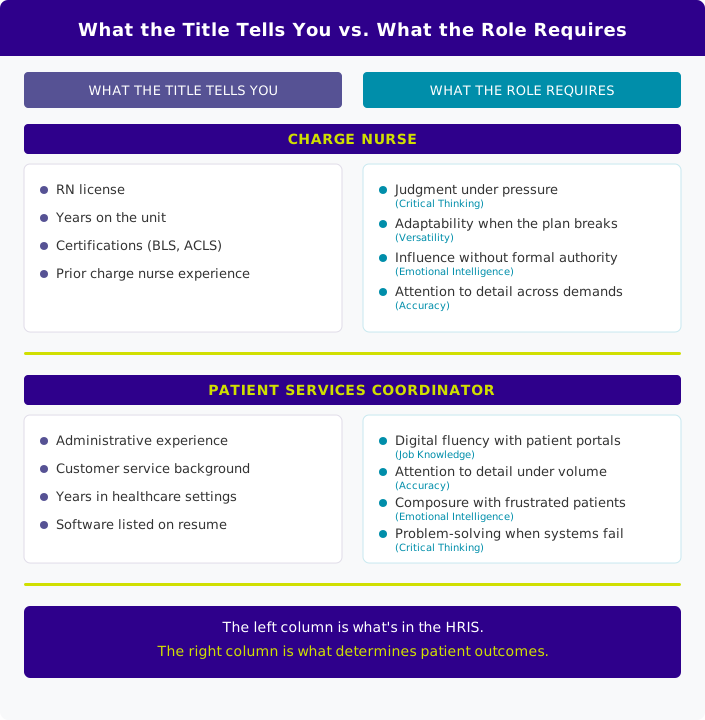
A charge nurse title doesn't tell leaders who can effectively navigate a crisis admission at two in the morning.
A patient services coordinator title doesn't reveal who will adapt fastest when a new digital workflow is introduced.
A supervisor's years of experience don't necessarily indicate an ability to coach, influence, or lead others through change.
Patients don't interact with strategies.
They experience people.
And when staffing shortages, burnout, and workforce instability already place pressure on the system, every talent decision carries greater consequences.
What Happens When Capability Data Is Missing
The impact rarely appears all at once.
It shows up as a cycle.
A role is filled by someone who looks qualified on paper.
The individual performs adequately in some areas but struggles in others.
Development resources are invested.
Performance remains inconsistent.
Frustration builds.
Turnover follows.
The organization hires again. The same process repeats. This isn't necessarily a bad hire. It's often a predictable mismatch.
-
The manager who interviews exceptionally well but struggles to coach others.
-
The clinician who demonstrates strong technical expertise but has difficulty adapting to changing workflows.
-
The high-performing individual contributor who is promoted into leadership before demonstrating leadership readiness.
Without capability data, organizations frequently discover those gaps only after a person is already in the role.
By then, the cost has already been incurred.
What We See Across Industries
While the examples often look different, the underlying challenge is remarkably consistent.
Organizations want to move toward skills-based decision making.
What they lack is a reliable way to measure the capabilities that make those decisions possible.
We've seen this challenge emerge in restaurants, healthcare organizations, senior living communities, hospitality companies, and service organizations of every kind.
In restaurant operations, we've helped clients strengthen leadership selection by introducing objective measures of leadership capability before promotion decisions occur. At PDQ, managers who passed Corvirtus assessments proved 5x more likely to build strong, high-performing teams once validated assessment data informed leadership selection.
Clinical credentials indicate who is qualified to perform a role.
They don't necessarily indicate who will thrive in a highly relational environment that requires emotional intelligence, adaptability, composure, and attention to detail every day.
That's why many senior living organizations partner with us to identify the competencies most closely tied to long-term success before hiring decisions are made.
Sunny Vista Living Center is one example. Over a long-standing partnership, first-year turnover decreased by 21.5% as hiring decisions became increasingly informed by assessment data designed to evaluate the competencies and behaviors most critical for success within their environment.
Different industries.
Different roles.
The same underlying principle.
Better decisions require better data.
Skills-First Isn't a Hiring Strategy
This is where many organizations get stuck.
They treat skills-based hiring as a recruiting initiative. It isn't.
It's an operating model.
-
The same capability data that improves hiring decisions strengthens employee development.
-
The same capability data that informs development improves succession planning.
-
The same capability data that strengthens succession planning improves internal mobility.
When organizations understand both what people can do today and what they are capable of becoming tomorrow, talent systems begin reinforcing each other rather than operating independently.
Suddenly, promotion decisions become more objective. Development investments become more targeted. Career pathways become more credible. And leaders gain visibility into potential long before a title change forces the conversation.
The Strategy Was Right
The CHRO presenting the skills-first roadmap wasn't wrong.
The industry wasn't wrong.
Skills-based talent strategies address a real challenge.
But strategies don't change organizations.
Systems do.
The organizations making the greatest progress aren't simply talking differently about talent. They're measuring different things. They're moving beyond credentials and job titles toward a deeper understanding of capability.
The challenge isn't a shortage of talent. It's a shortage of visibility into talent. Opportunity@Work estimates that more than 70 million Americans have developed valuable capabilities through work experience, military service, community colleges, apprenticeships, and other pathways. Yet many remain invisible to traditional hiring systems because those systems still prioritize proxies over demonstrated potential.
Because the question is no longer whether organizations should embrace a skills-first future. The question is whether they have the data to make it real. Skills-first organizations succeed not because they use different language.
They succeed because they can see something others can't.
The capabilities underneath the resume.
That's where a skills strategy stops being a philosophy and becomes a workforce system.
FAQ
How do I know if my organization is ready for a skills-based talent strategy?
Readiness starts with capturing the capabilities of your workforce, and looking beyond experience and tenure for talent decisions. If you are measuring job titles and certifications but nothing about how people think, adapt, or influence, you have a measurement gap. Assessments evaluate the foundational competencies, values and preferences, skills, and behavioral tendencies that predict performance. That data is what turns a skills-first strategy from a slide deck into decisions that change outcomes.
What capabilities do Corvirtus assessments measure?
Assessments measure a range of competencies like Critical Thinking, Versatility, Emotional Intelligence, Accuracy and Attention to Detail, and Readiness to Learn. Each assessment is selected or tailored to the job responsibilities and culture. These aren't generic screeners. They're precision instruments built from 40 years of industrial-organizational psychology.
How do capabilities assessments differ from personality tests?
Personality tests describe broad tendencies. Our hiring assessments measure specific, validated competencies tied to performance in your roles and culture. We evaluate how someone thinks under pressure, adapts to change, influences others, and maintains accuracy when volume and interruptions increase. The result is operational, capability data that informs hiring, development, and succession decisions—not a personality label.
How does Corvirtus support skills-based hiring in healthcare?
Healthcare roles have shifted significantly. Telehealth, electronic records, and team-based care models now require capabilities that job titles and certifications were never built to describe. We design role-specific assessments that measure the competencies those positions actually demand in observable, specific terms: judgment, digital fluency, composure, accuracy and attention to detail. With a capabilities-first approach Corvirtus assessments reduced first-year turnover by over 20 percent within healthcare.
What is a competency model and how does it connect to skills-based decisions?
A competency model translates a role into specific capabilities, behaviors, and knowledge required for success. We build these models to reflect your organization’s culture, goals, and performance expectations, then tie them directly to validated assessments that measure those competencies in candidates and employees. That shared measurement layer is what turns skills-based hiring, development, and succession planning into an operational system instead of an aspirational framework.
How do capabilities assessments improve employee development and succession planning?
When you assess capabilities at hire, you create a data foundation that moves with the employee. Development efforts can target documented gaps rather than assumed ones. Succession planning can identify leadership capacity based on demonstrated competencies, not tenure. The same capability data that supports the hiring decision shapes the growth path and feeds the leadership pipeline. Those systems begin to align and reinforce each other instead of operating in silos.