
Skip to content

    Strong and healthy company and workplace cultures do not happen by accident

    They are intentionally designed through culture building – and are key to growing a strong and healthy brand. We offer a variety of organizational culture and leadership solutions to help design and build a strong and healthy culture.

    CultureMap™

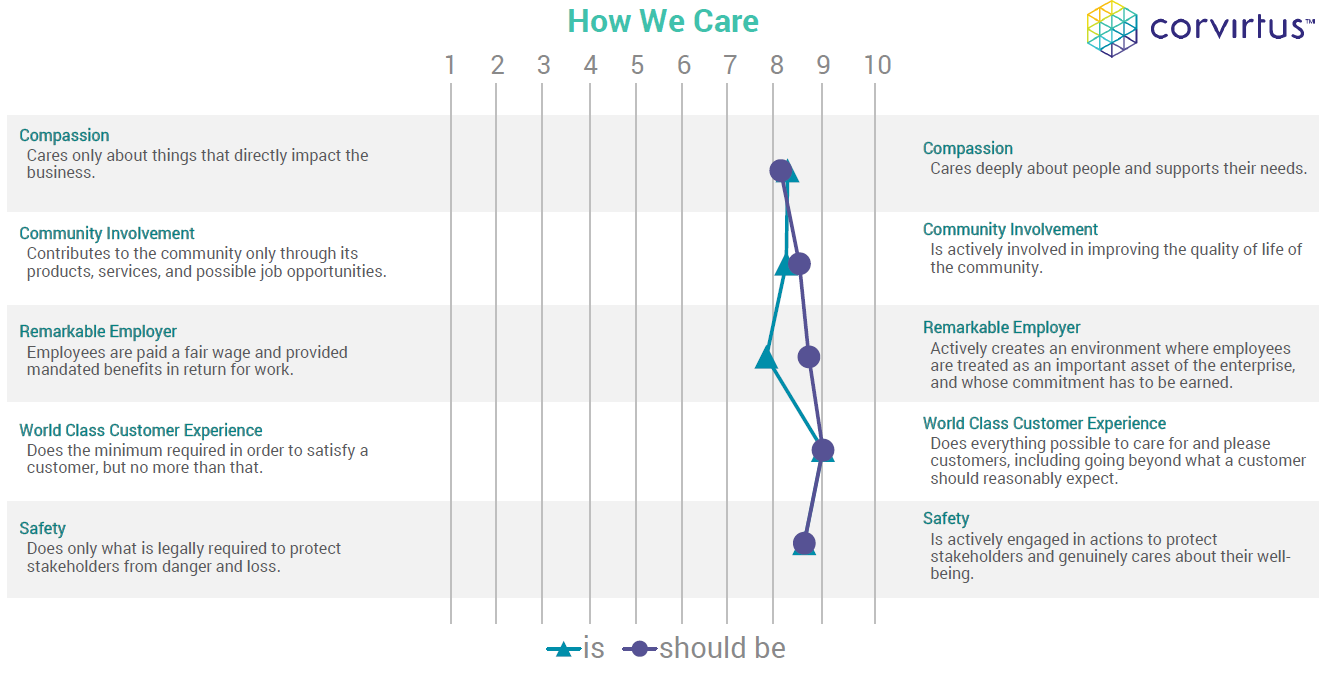
    Our culture building online assessment measures your team's perspective on 23 dimensions of culture and highlights gaps between where your company and workplace culture currently is and where it needs to be. Act on differences in culture by department, level, tenure, and location. The CultureMap process aligns teams, describes how your culture drives performance and serves as an input to aligning people processes with your culture.

    Corvirtus CultureMap-1

    Visioneering™

    Our process for culture building captures your Leadership Team’s vision for the future of your company and how it is to be achieved.  Teams who engage in this process achieve team alignment with your intended culture and strategy, build best-in-class brands, are able to articulate and internalize meaningful company values, and increase performance and accountability.

    Culture Building Corvirtus

    "Corvirtus has been a real 'difference-maker' for us, largely by helping us define what makes us different. With Corvirtus guiding our leadership team through the difficult but essential process of analyzing our own organization, we were able to refine our mission statement, define our guiding principles and our commitments to our various stakeholders, determine the critical features of our brand based on what differentiates us from other organizations, and arrive at a clearly stated vision and plan for our organization’s future. As a result, our organization has become the world leader in our rare disease space."

    Ron Bartek, President and Co-Founder fara logo white

    Growing a culture of opportunity

    Hiring and promoting on the basis of culture, or culture-fit has been accused in recent years of being a proxy for bias and discrimination. Our response: if making decisions based on your company culture is bias – you might need a new approach. If you define culture as your definition of success and how it is achieved, hiring for the mindsets, abilities, and values that will drive that company and workplace culture is vital. In this video, our Managing Director, Jennifer Yugo, shares how your culture should be a good story and how hiring for culture can obliterate bias.

    Our process

    Step 1

    Discover

    Interview the company’s key decision makers and influencers for perspectives on the what, how, and why of success.

    Step 2

    Define

    Facilitate several half-day meetings with the Leadership Team and up-and-comers to discuss the company’s intended future, including what it means to achieve desired outcomes.

    Step 3

    Draft

    Work as a scribe for the group to voice a detailed and inspiring road map to your company’s success.

    Step 4

    Align

    Implement your vision through education, integration into policies and procedures, and measurement.

    1. We’ve looked at various tools and solutions for culture–what specifically makes Corvirtus different, and why should we choose you over alternatives or building this capability in-house?

    Deep industry expertise: Over 40 years working specifically in aviation, healthcare, food service, among other industries–we’re not generalist consultants applying generic frameworks. We understand that your company, culture, and what's needed for sustained success is unique.

    Comprehensive culture-building approach: We provide support from culture articulation through implementation, not just a single survey or assessment tool. Many vendors or consultants offer one-and-done solutions; few help you articulate what success means in your organization, translate that into measurable behaviors, and a plan for building your culture through hiring, developing, listening, and engaging your teams.

    Partnership: Dedicated account teams with talent management, culture, and doctorate level industrial-organizational psychologists.

    First-Glance Understanding: Everything is designed for frontline leaders. No certifications required. We love to teach and train but love that you can understand our solutions and materials even more.

    Mid-market optimization: Enterprise-quality solutions without high-price minimums.

    Resources:

    2. What’s the actual ROI of culture-building for a company our size, and how quickly can we expect to see measurable results?

    When we've led ROI and validation studies we've tracked turnover reduction at 40 percent, 50 percent lower cost-per-hire, and 12 percent greater productivity. To use restaurants as an example, clients have reduced turnover from over 100 percent annually to under 40, generating millions in savings through reduced replacement costs alone.

    Actualizing on ROI follows intentional implementation. We can support articulating your culture and then strengthening it or measuring how your current culture and core promises to stakeholders are lived. Sometimes hiring assessment tools and leadership development and coaching solutions are implemented that score quick wins. Retention grows as culturally connected employees stay longer, then productivity increases as teams operate with shared values enabling faster decision-making. Investment typically pays back through reduced replacement costs, with additional gains from improved productivity, a stronger customer experience, and stronger employer brand attraction.

    Resources:

    3. How does your pricing model work? What’s the total investment required to implement culture-building across our entire operation?

    Corvirtus pricing scales based on the breadth of the solution. Assessments, for hiring/promotion, or development, as well as surveys are usually provided through an unlimited annual license based on your size. 

    We provide transparent cost modeling during discovery, showing projected costs against anticipated savings from turnover reduction and hiring efficiency gains. Many clients engage on multi-year partnerships – typically three-year agreements – to fully realize culture transformation benefits and maximize return on investment.

    4. How long does full implementation take for an organization with our footprint (multiple locations/thousands of employees), and what resources do we need to dedicate internally?

    Implementation follows a phased approach: discovery and culture definition establishes your organizational blueprint, a pilot if it's beneficial, then enterprise rollout scales validated processes across your entire footprint.

    If we're supporting you in defining or strengthening your culture, a cross-departmental 'visioneering' group is usually created to own the process.

    Internal resource requirements include a dedicated champion or two to drive adoption. We find cross-departmental task forces can be helpful once culture goals are defined as the plan is executed.

    Full culture transformation unfolds across multiple stages. Measurable improvements appear progressively–pilot results inform broader rollout, early adopters become internal advocates, and cultural consistency strengthens as more employees experience aligned practices.

    Resources:

    5. Can your culture-building approach scale across diverse locations, departments, and employee populations while maintaining consistency–or do we risk creating fragmented cultures?

    The CultureMap™ process measures where your culture is now and where it should be across departments, locations, organizational levels, and tenure groups. It looks specifically at how – identifying where culture is strong versus fragmented before intervention begins. This diagnostic precision enables targeted action rather than organization-wide programs that waste resources.

    We help you define 'core non-negotiables'– brand-essential values that must remain consistent everywhere – while allowing operational flexibility for location-specific adaptation. For example, airline industry clients maintain unified safety culture across all locations while permitting customer service expression that reflects regional differences.

    This approach prevents homogenization while ensuring strategic alignment. Regular CultureMap measurement tracks whether expansion dilutes or reinforces your intended culture.

    Resource: Learn the complete framework: How to Build a Strong and Healthy Organizational Culture 

    6. How does your approach address the unique challenges of our industry–particularly high-volume hiring, thin margins, and the consequences of getting it wrong in our sector?

    With over 40 years of experience in aviation, healthcare, food service, and other industries, Corvirtus understands that sector-specific challenges require specialized solutions, not generic personality tests or engagement/culture surveys.  We start with your definition of success and the employee experience you need that will support your success. With airlines and aviation clearly safety, navigating labor relations, and operational consistency are key. With healthcare, we've focused on indicators of retention and patient care beyond credentials, and building cultural alignment across departments. Hospitality, restaurants, and food service demands high-volume hiring efficiency, and solutions with first-glance understanding that ensure a consistent guest experience across geographically dispersed locations.

    Once your core values are captured, we can also create competency models specific to your organization and/or job groups. These can form the blueprint for hiring, employee development, and all activities within your employee journey. 

    Resources:

    7. Can you share specific results from companies similar to ours in [industry]–including turnover reduction, quality of hire improvements, and cultural transformation outcomes?

    Restaurant chains: Clients have reduced turnover from over 100% annually to below 40% within 18 months, generating millions in annual savings through reduced replacement costs, training efficiency, and operational consistency enabled by team stability.

    Healthcare organizations: Improved retention in critical nursing leadership roles by 35%, reducing patient care disruption from leadership turnover while accelerating time-to-full-productivity for new hires through better cultural alignment.

    Aviation and other industries: Enhanced safety culture measurement scores by 28% while simultaneously accelerating hiring cycles by 40%, demonstrating that cultural rigor and hiring speed aren’t mutually exclusive.

    These results stem from systematic cultural definition, scientifically validated assessment integration, and ongoing measurement enabling continuous optimization.

    Resource: Explore detailed case studies 

    8. What metrics will we actually be able to track to prove culture change is happening–and how does your CultureMap™ process distinguish between surface-level compliance and genuine cultural transformation?

    You’ll track both leading and lagging indicators connecting cultural inputs to business outcomes. Leading indicators include cultural alignment scores by hiring cohort, quality-of-hire ratings, interview-to-offer ratios, and time-to-productivity measurements. Lagging indicators include 90-day retention rates, 12-month turnover by department and location, employee engagement scores, customer satisfaction metrics, and operational performance indicators.

    CultureMap™ distinguishes genuine transformation from survey gaming by measuring behavioral consistency rather than stated preferences. It tracks whether actual decisions–hiring choices, promotion patterns, conflict resolution approaches–reflect stated values. Employees can learn to give “correct” survey answers, but behavioral patterns reveal whether culture is lived versus posted on walls.

    Longitudinal tracking shows trajectory rather than snapshots, identifying whether culture strengthens or drifts over time.

    Resource: Learn what to measure: How to Build a Strong and Healthy Organizational Culture

    9. We’re in rapid growth mode. How does your culture-building approach help us scale/transform without losing what made us successful in the first place?

    The CultureMap™ process establishes your cultural baseline before growth acceleration. It can document what currently makes you successful before expansion potentially dilutes it. This baseline becomes your reference point for monitoring whether new locations, departments, or market expansions maintain cultural consistency.

    Hiring assessments, or related solutions (like realistic job previews), ensure new employees reinforce rather than dilute culture as you scale. Instead of hoping new hires 'figure out' your culture through osmosis, you’re explicitly selecting for cultural alignment from day one–critical during rapid expansion when you’re hiring quickly.

    We help organizations distinguish core non-negotiables –elements that must remain consistent everywhere–from operational flexibility where adaptation specific to a location or department makes sense. This framework enables rapid hiring without sacrificing what made you successful.

    Resources:


    Ready to Build a Stronger Culture?

    Contact Corvirtus to discuss how culture-building can transform your talent management approach and deliver measurable business results.

    📆Schedule a Consultation

    For more insights on organizational culture, visit our blog or explore our company leadership and about us pages.

    Ready to learn more?