
Restaurant Managers Influence Everything
A restaurant manager’s impact reaches far beyond scheduling, inventory, and ensuring a smooth shift.
- They influence engagement at every level. When leaders are fully engaged, 65% of their team members report being fully engaged as well.
- They play a critical role in retention, with nearly half of departing restaurant employees citing poor management as a reason they left.
- They reinforce the culture employees experience every day, shaping whether people feel valued, supported, and motivated to stay.
- And because replacing a restaurant manager can cost nearly $12,000, investing in the right leaders has a direct impact on both people and performance.
Strong restaurant managers shape team culture, create consistency in the guest experience, develop future leaders, and drive operational results. They influence retention, engagement, customer satisfaction, and ultimately profitability.
That’s one reason so many restaurant organizations are rethinking how they identify and develop leaders. At Corvirtus, we’ve spent decades partnering with hospitality, restaurant, retail, and healthcare organizations to better understand what separates high-performing leaders from those who struggle to gain traction.
One finding consistently emerges: the most successful managers are not defined by experience alone. They share a set of leadership competencies that drive both people and business outcomes.
The challenge for operators isn’t simply defining these competencies. It’s creating a consistent and objective way to identify them during hiring, promotion, and development decisions.
1. Accountability & Ownership
Great managers don’t blame circumstances.
When something goes wrong, they focus on solutions. In our work with restaurant leaders, ownership and accountability consistently emerge as two of the first competencies they name.
High-performing restaurant managers hold themselves accountable for results while creating clear expectations for others. They follow through on commitments, address issues directly, and take ownership of both successes and setbacks.
You might observe this competency when a manager:
- Addresses performance issues quickly
- Follows through on commitments
- Takes responsibility for their own mistakes and operational challenges within their four walls
- Creates clarity around expectations
Without accountability, teams often experience inconsistency and frustration.
With it, standards become part of the culture.
This competency often becomes visible long before someone holds a general manager title. In many of our restaurant leadership assessments and competency modeling projects, accountability shows up as an early indicator of leadership readiness. Individuals who consistently take ownership, follow through on commitments, and address problems directly often adapt more successfully to broader leadership responsibilities.

2. Coaching & Development
One of the biggest differences between average and exceptional managers is their ability to develop others. In Corvirtus engagement and retention surveys, coaching and development consistently emerge as the clearest opportunity, with 42 percent of employees wanting stronger support in this area.
Top-performing restaurant managers are thinking beyond today’s shift. They are building the confidence, judgment, and capability future leaders will need.
Strong coaching involves:
- Providing frequent feedback
- Recognizing strengths
- Helping employees learn from mistakes
- Building confidence and capability
Organizations that consistently promote strong leaders often have managers who view employee development as part of their daily responsibilities rather than an occasional event. Many restaurant organizations, however, unintentionally promote top performers into leadership roles without evaluating their willingness or ability to develop others. Yet coaching is often the competency that determines whether a leader can scale their impact beyond their own performance. When we help organizations build leadership profiles for restaurant managers, coaching and talent development frequently emerge among the strongest differentiators between managers who maintain high-performing teams and those who experience constant turnover and staffing challenges.
3. Communication & Influence
Restaurants are places of constant change and movement. Managers make dozens of decisions that influence employees, guests, and business results. Effective leaders must process information quickly, adapt to changing conditions, communicate clearly, and maintain standards even during periods of high volume and operational complexity. This combination of speed, complexity, and people leadership is one reason restaurant management requires a unique blend of communication and influence skills.
Information must flow effectively between leadership, employees, guests, and support functions.
The strongest managers communicate with clarity while adapting their message for different audiences.
This competency demands:
- Setting expectations clearly
- Delivering difficult feedback effectively
- Navigating conflict proactively
- Gaining buy-in and a culture that supports change
Strong communication reduces misunderstandings and creates alignment across the operation. At Corvirtus, we view leadership in restaurant operations through two connected lenses: people and results. In our Personal Insight and Development Report (which you can take and/or share and receive a complimentary report), and many of our performance feedback tools, we isolate the drivers that support or derail success with leading people and growing business results. The most effective restaurant managers do both in observable, specific terms.
4. Operational Excellence
People skills matter.
So do results.
Effective restaurant managers combine leadership ability with operational discipline.
They understand how systems, processes, and standards work together to create consistency.
Examples include:
- Maintaining food and safety standards
- Managing labor effectively
- Monitoring key operational metrics
- Creating consistency across shifts
Strong leaders recognize that operational excellence and people leadership are not competing priorities—they reinforce one another. At Corvirtus, we often describe leadership as the intersection of people and results. Restaurant operators sometimes view operational excellence and people leadership as separate skill sets when in reality the two are inseparable. Strong systems create consistency for employees. Strong leaders ensure those systems are followed. The most effective managers excel at both.
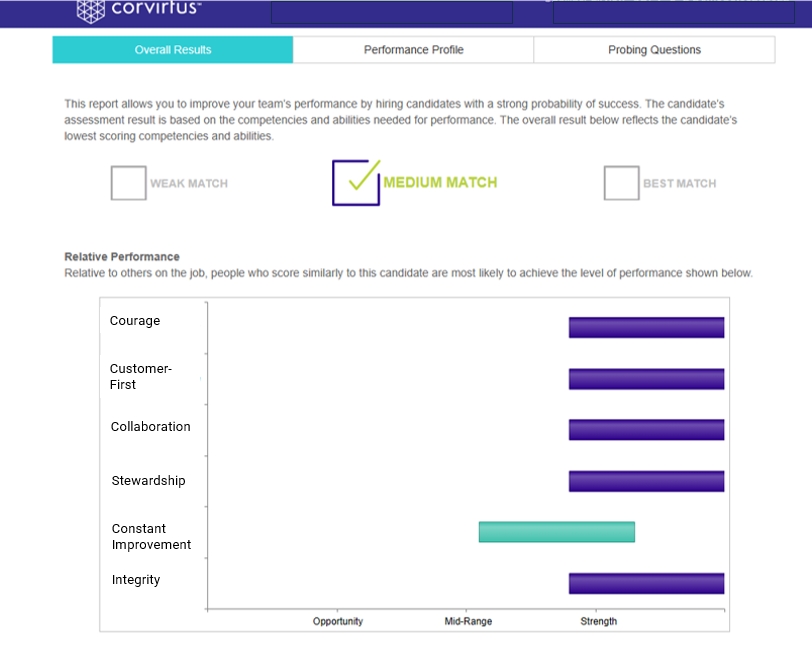
Sample assessment result built to an organization’s culture.
5. Guest-Centered Leadership
Exceptional managers understand an important truth: employee experience and guest experience are connected. The gap between the two is smaller than it often appears. When employees know what is expected, feel supported through tough challenges and shifts, and trust their manager to respond consistently, they are better equipped to deliver the intended guest experience. Leaders who both teach and deliver hospitality, reinforce service expectations, and respond thoughtfully to guest concerns help establish customer-focused cultures. Guest-centered leaders shape the daily behaviors that influence what guests notice, remember, and say about the experience long after the visit ends.
Guest-centered leaders:
- Stay connected to the guest experience — they notice patterns, seek guest input, and build connections
- Model and coach hospitality in real time
- Connect the employee experience to the guest experience by removing obstacles, staying fully staffed and fully trained, and providing the support and leadership each person uniquely needs
- Own the recovery when something goes wrong — listening carefully, acknowledging the impact, resolving with urgency, and following up as appropriate
They understand that creating an exceptional guest experience starts by creating an environment where employees can perform at their best.
6. Decision Making
Restaurants require hundreds of decisions every week.
Some are routine.
Others can significantly impact profitability, staffing, or customer satisfaction.
Strong managers gather information, evaluate options, and make timely decisions without becoming paralyzed or burned out by the workload, responsibility, or inherent uncertainty.
They are able to:
- Prioritize effectively
- Balance competing demands
- Solve problems under pressure
- Adapt when circumstances change
Because restaurant environments move quickly, sound judgment often becomes a critical differentiator between managers who derail and those who consistently perform.
7. Talent Building
Perhaps the most overlooked competency is the ability to build a leadership bench.
Exceptional managers recognize potential in others and actively prepare employees for larger roles.
This means:
- Identifying emerging leaders
- Providing stretch opportunities
- Delegating appropriately
- Supporting internal promotion efforts
Organizations with strong leadership pipelines typically have managers who see talent development as part of their responsibility.
Not just HR’s.
Not their supervisor or corporate.
Their own.
One of the questions we frequently hear from restaurant leadership is:
“How do we know who is ready for the next level?”
Many restaurant organizations use leadership assessments, structured interviews, and competency-based development programs to identify employees with the potential to succeed as assistant managers, general managers, or multi-unit leaders. Creating this visibility early helps organizations build stronger succession pipelines while reducing the risks often associated with promotion decisions.
Can You Measure These Leadership Competencies?
Many restaurant companies still rely heavily on intuition when selecting managers.
Yes, experience matters.
Yes, interview performance matters.
References matter for external hires.
But decades of practical research, data, and experience show that structured and objective methods for selection and development outperform gut instinct alone when predicting future job performance.
That’s why leading restaurant operators increasingly pair interviews with validated hiring assessments and structured evaluation processes.
At Corvirtus, we often encourage organizations to think about leadership selection the same way they think about food safety or operations. Consistency is table stakes.
A well-designed restaurant leadership assessment doesn’t replace human judgment. Instead, it provides additional information about a candidate’s leadership tendencies, work style, decision-making approach, and potential strengths or risks. Combined with structured interviews and thoughtful onboarding, assessments help leaders make more informed hiring and promotion decisions.
The goal isn’t to remove the human element.
The goal is to make better decisions about humans.
Building Better Restaurant Leaders
The best restaurant managers don’t simply run shifts.
They create environments where employees want to stay, guests want to return, and future leaders can grow.
The seven competencies outlined above provide a practical framework for understanding what successful restaurant leadership looks like. They can also serve as a foundation for hiring, promotion, coaching, and succession planning efforts.
At Corvirtus, we’ve seen organizations transform leadership outcomes when they move from “I know a good manager when I see one” to clearly defining, measuring, and developing the competencies that drive performance.
Because when leadership success stops being subjective, building great leaders becomes far more repeatable.
FAQ
What competencies should be included in a restaurant manager assessment?
The most effective restaurant manager assessments typically evaluate competencies related to accountability, coaching, communication, operational excellence, guest focus, decision making, and talent development. While specific models vary by organization, these competencies frequently appear in leadership success profiles across the restaurant industry.
What skills should a restaurant manager have?
Strong restaurant managers typically demonstrate accountability, coaching ability, communication skills, operational excellence, guest focus, decision making, and talent development.
What is the most important competency for a restaurant manager?
While every organization is different, people leadership competencies such as coaching, accountability, and communication often have a significant impact on employee engagement and retention.
How do you assess restaurant manager candidates?
Many organizations use a combination of structured interviews, behavioral questions, reference checks, and validated leadership assessments to evaluate candidates.
What makes a successful restaurant leader?
Successful restaurant leaders balance strong people leadership with operational execution. They develop employees, create positive guest experiences, and consistently drive results.