
Hiring assessments play a critical role in restaurant hiring, where turnover, speed, and culture fit can make or break team performance. The best hiring assessments help restaurant leaders identify candidates who align with the role, the pace, and the values of the business. But not all hiring assessments are built for the realities of hospitality. Some hiring assessment tools lack validation, miss restaurant-specific traits, or fail to predict long-term success. In this article, you'll learn how to evaluate hiring assessments, spot the warning signs of weak tools, and choose a solution that supports better hiring, stronger retention, and more consistent results.
Many hiring solutions promise better performance, stronger culture, and lower turnover. Some do that reasonably well. The gap appears when restaurant hiring requires more than broad claims. In hospitality, the question is not whether an assessment sounds credible. It is whether the assessment is built to measure what restaurant performance actually looks like: guest service under pressure, teamwork during rush periods, and alignment with the values that shape retention. This article outlines seven warning signs that a hiring assessment may not hold up for restaurant hiring decisions.
By the end, you will have a clearer standard for evaluating assessment tools—what holds up under scrutiny, what does not, and which signals deserve closer attention.
Quick guide: 7 signs a hiring assessment fails restaurants
- Validity? Show it. The vendor cannot produce peer-reviewed studies or job-specific validation evidence.
- One size fits none. The questions don't seem job-related and don't reflect restaurant realities like flexibility, guest interaction, or teamwork.
- Forty-five minutes? Hard pass. The assessment takes too long, which drives candidate drop-off in high-volume hiring.
- All skill, no fit. The tool measures cognitive ability but misses culture and values alignment.
- Fairness without proof. The vendor cannot demonstrate adverse impact analysis or legal defensibility across demographic groups.
- Score, then what? Results do not connect to structured interview questions, coaching, or next-step guidance.
- Stuck in the past. The content has not kept up with current restaurant challenges or operating realities.

How we identified these warning signs
Restaurant hiring comes with its own operational reality: high application volume, tight timelines, and the need to hire people who will stay long enough to matter. We looked at what separates validated hiring assessments from tools that simply add one more hoop to jump through.
- Validation research: Does the assessment show documented evidence that it predicts job performance in roles like yours?
- Restaurant relevance: Is it built for hospitality, or is it dressed up generic content?
- Candidate experience: Will applicants actually finish it, or drop off halfway through?
- Culture measurement: Does it measure values and fit, not just raw ability?
- Legal defensibility: Can the vendor show adverse impact analysis and fairness data?
- Actionable output: Do the results lead to better interviews and onboarding, or just another score?
The 7 warning signs of unreliable restaurant hiring assessments
1. Validity? Show it.
This is the most important red flag. When a vendor cannot produce validation studies, you're essentially gambling on whether their assessment actually predicts performance. Validity evidence should show a clear link between assessment scores and on-the-job outcomes like retention, guest satisfaction scores, or performance ratings.
Successful assessments are evidence-based and driven by research. Each tool goes through rigorous validation studies specific to the roles and industries where it's deployed. This means when you use an assessment for restaurant hiring, you're working with data that proves the connection between candidate scores and real-world success.
Ask any vendor for their technical manual or validation documentation. If they can't produce it—or if the studies were conducted in industries completely different from yours—that's a sign to keep looking.
What to look for
- Criterion-related validity studies: Research showing assessment scores correlate with job performance metrics in hospitality or similar fast-paced service environments
- Content validity documentation: Evidence that questions were developed based on actual job analysis from restaurant roles
- Regular revalidation: Studies conducted within the past few years, not decades-old research from unrelated industries
- Transparent methodology: Clear explanation of sample sizes, statistical methods, and performance criteria used
Validity evidence pros and cons
Pros of validated assessments:
- Predict actual job performance with documented accuracy
- Support legal defensibility in hiring decisions
- Give you confidence that hiring investments will pay off
Cons of unvalidated tools:
- No proof the assessment measures anything relevant to restaurant success
- Higher legal risk if challenged on hiring practices
- Potential for false positives that lead to bad hires
2. One size fits none.
Restaurant work includes irregular schedules, direct guest interaction, physical demands, and teamwork under pressure. Generic assessments are built to do broad screening, not measure what restaurant performance actually looks like.
You need questions tied to the conditions your team faces every day. Can a candidate stay composed during a rush? Respond well when a guest is frustrated? Step in when a shift needs coverage? Those are the operational realities the assessment should be built to measure. A strong consultative assessment partner can build those realities into the assessment itself.
What to watch for
- Industry-agnostic scenarios: Situations that could apply to any job but don't reflect restaurant realities
- Missing hospitality competencies: No measurement of guest service orientation, teamwork under pressure, or flexibility
- Abstract cognitive tests only: Is it giving standardized testing vibes? Watch for abstract puzzles with no behavioral or values-based questions and no real job context.
Generic assessment pros and cons
Pros:
- Often available at lower initial cost
- Quick implementation without customization time
- May cover basic cognitive screening needs
Cons:
- Questions don't reflect the realities of restaurant work
- Candidates may not see the relevance to the role they're applying for
- Results don't predict success in hospitality-specific competencies
3. Forty-five minutes? Hard pass.
In high-volume restaurant hiring, every minute counts. If your assessment takes much longer than 20 minutes for a frontline or hourly role, you're losing candidates before they even finish. Industry data shows that lengthy application processes significantly increase drop-off rates, especially for hourly positions.
A successful assessment partner balances thoroughness with respect for applicants' time. High completion rates—often 90-95%—mean you're not losing qualified candidates to assessment fatigue.
Long assessment features
- A large number of questions with the same format: 100+ similar sounding questions in the same format doesn't deliver a stellar candidate experience. Consider varying the kinds of questions (e.g., scenario based, selecting the best descriptors, choosing actions from a list).
- Multiple timed sections: Separate cognitive, personality, and skills tests that add up to an hour or more
- Complex instructions: Confusing formats that slow candidates down and increase frustration
Long assessment pros and cons
Pros:
- May gather more data points on each candidate
- Can include multiple assessment types in one sitting
- Some candidates view length as a sign the employer is thorough
Cons:
- High candidate drop-off, especially in volume hiring
- Applicants may rush through later sections, reducing data quality
- Creates negative first impression of your employer brand
4. All skill, no fit.
Cognitive ability tests have a role, but they are built to measure only part of the hiring decision. They do not tell you whether a candidate will align with your team’s culture or the values that shape the guest experience. In restaurant hiring, that gap matters. Skills can be trained. Values alignment, work style, and the way someone shows up under pressure are often stronger indicators of whether they will stay and perform.
Successful assessments for restaurants measure more than raw ability. They evaluate values, work styles, and personality alongside job-related capabilities, giving you a clearer picture of whether a candidate is likely to thrive in your environment. We've delivered a culture discovery process, called the CultureMap, that adds another layer by helping you define your culture in observable, specific terms, so you are measuring fit against the values your organization actually expects—not abstract concepts or generic labels.
Culture measurement features
- Values alignment items: Questions that reveal whether candidates share your organization's priorities
- Work style preferences: Insights into how candidates prefer to collaborate, handle stress, and approach tasks
- Realistic job previews: Scenarios that help candidates self-select based on accurate expectations
Culture measurement pros and cons
Pros:
- Predicts retention and engagement beyond first-week performance
- Helps build cohesive teams that work well together
- Supports employer branding by showing candidates what you value
Cons of tools without culture measurement:
- You may hire skilled candidates who don't fit your team
- Higher early turnover when expectations don't match reality
- Missed opportunity to reinforce organizational values during hiring
5. Fairness without proof.
Any assessment used in hiring should be fair across demographic groups. If a vendor hasn't conducted adverse impact analysis or can't show you the results, you're taking on legal risk. The EEOC's Uniform Guidelines on Employee Selection Procedures set clear standards for fairness in pre-employment testing.
Assessment development starts with fairness at the core—not as an afterthought. Documented adverse impact analyses and ongoing monitoring ensure that hiring decisions supported by Corvirtus tools meet legal defensibility standards.
Adverse impact analysis features
- Group comparison studies: Data showing how different demographic groups score on the assessment
- Compliance: Evidence that selection rates don't disproportionately impact protected groups
- Regular monitoring: Ongoing tracking, not just a one-time study from years ago
Adverse impact analysis pros and cons
Pros:
- Reduces legal exposure in discrimination claims
- Supports diversity, equity, and inclusion goals
- Demonstrates commitment to fair hiring practices
Cons of tools without adverse impact data:
- Unknown legal risk if hiring decisions are challenged
- May unintentionally screen out qualified candidates from underrepresented groups
- No way to verify the tool supports your goals for building diverse teams
6. Score, then what?
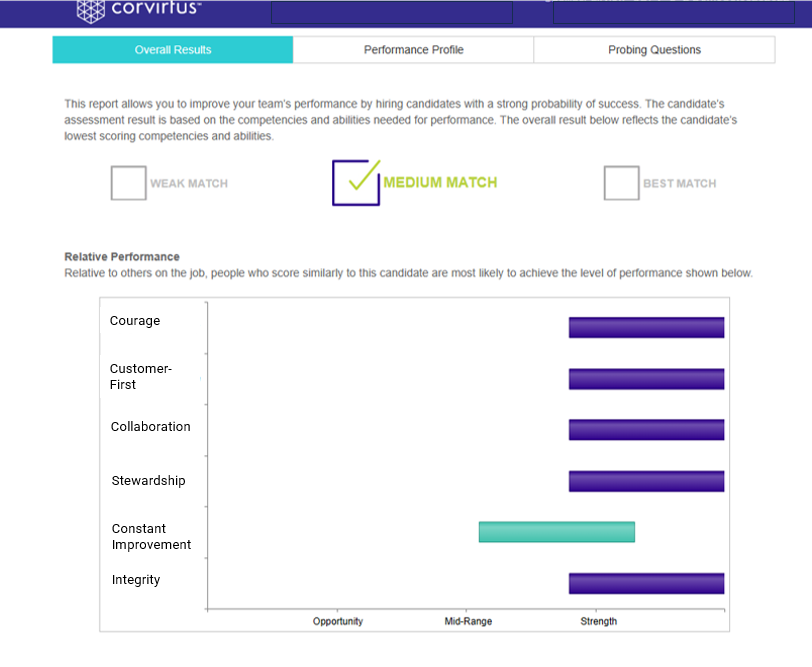
An assessment that ends with a score and nothing else leaves you guessing about next steps. The real value comes when results connect to structured interview questions, coaching recommendations, and onboarding guidance. Without this, you're only getting half the picture.
A strong assessment partner can also help you build a structured interview process—one that gives hiring managers a consistent, repeatable framework for making stronger hiring decisions across every restaurant.
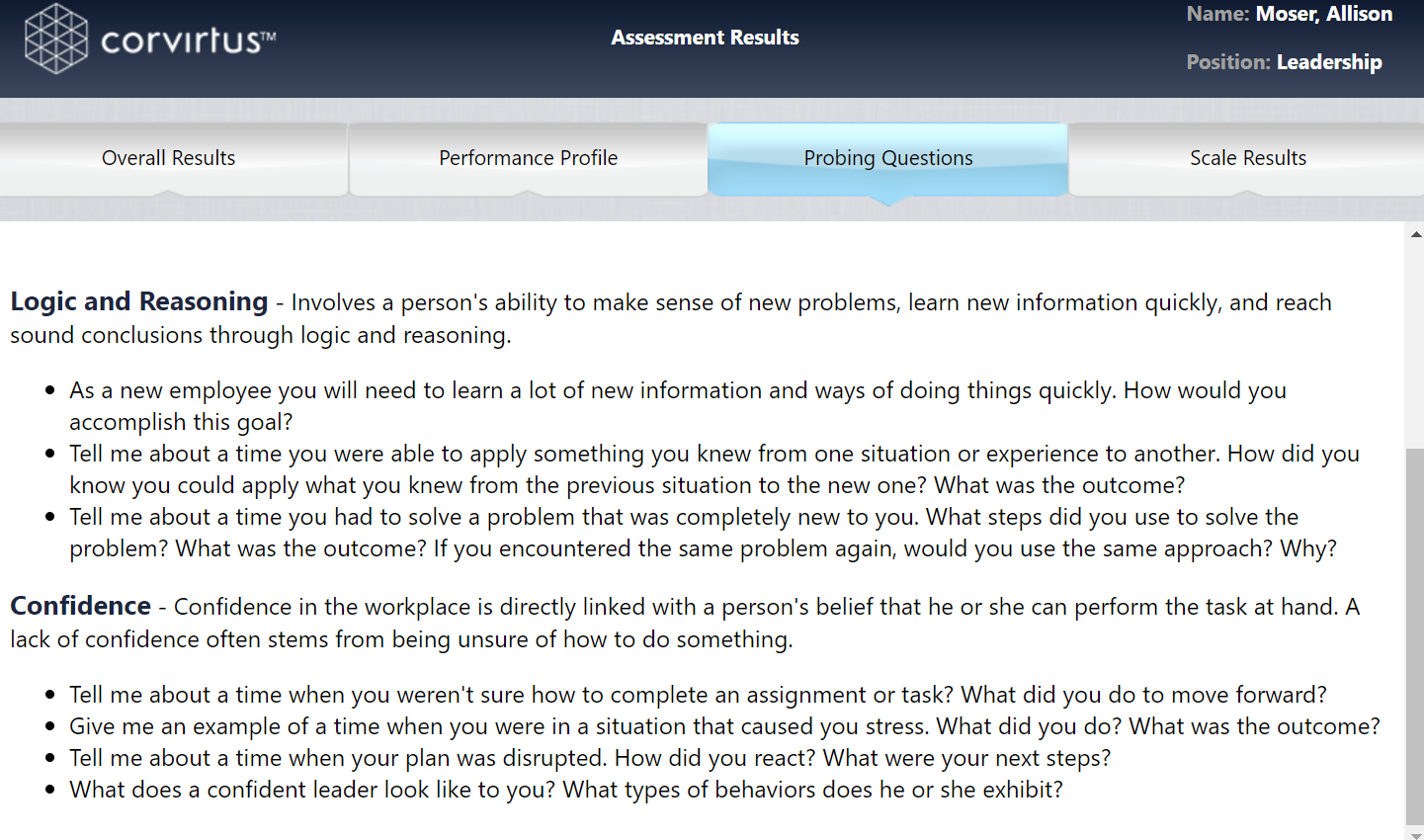
Strong assessment partners deliver recommended interview questions, and suggestions for development if hired, within the assessment results. This means you know exactly what follow-up questions to ask each candidate based on their unique profile. After hiring, results also guide early-tenure coaching to support new hire success from day one.
Video: watch a quick overview of an assessment result report.
Structured guidance features
- Interview question recommendations: Candidate-specific follow-up questions based on assessment results
- Coaching insights: Actionable recommendations for managers to support new hires
- Onboarding integration: Guidance that extends beyond the hiring decision into early development
Structured guidance pros and cons
Pros:
- Makes assessment data actionable throughout the hiring process
- Improves interview consistency and depth
- Supports new hire retention through targeted coaching
Cons of tools without guidance:
- Assessment data sits unused after the hiring decision
- Managers may not know how to interpret scores or act on them
- Missed opportunity to improve onboarding and early retention
7. Stuck in the past.
The restaurant industry has not stood still. Since 2020 alone, operators have had to adjust to labor shortages, shifting guest expectations, new service models, and evolving technology. If an assessment has not been meaningfully updated since 2015, it is measuring candidates against a version of restaurant work that no longer exists.
Look for vendors that regularly refresh their assessments through current job analysis and ongoing industry research. The questions should reflect the challenges your team faces now, not the operating conditions of a decade ago.
Outdated content features
- Dated scenarios: References to situations that no longer reflect modern restaurant operations
- No recent updates: Vendor cannot point to new assessments or innovations
- Disconnected from current challenges: Missing questions about topics like staffing flexibility, multi-channel service, or team communication
Outdated content pros and cons
Pros:
- Often available because the vendor hasn't invested in updates
- May have historical validation data (though potentially outdated)
- Familiar to teams who have used the same tool for years
Cons:
- Questions may confuse or frustrate candidates who don't recognize scenarios
- Validity evidence may not hold for today's job requirements
- Candidates may question whether your organization is current and innovative
Comparison table: Assessment reliability warning signs
| Warning Sign | Evidence-Based Assessments (Corvirtus) | Unreliable Assessments | Why It Matters |
|---|---|---|---|
| Validity | ✓ Published studies | ✗ No documentation | Predicts actual job performance |
| One-Size: Lacks Industry-Specific Content | ✓ Restaurant-relevant | ✗ Generic content | Measures hospitality competencies |
| Completion Time | ✓ 5-20 minutes for frontline hourly roles; 30 minutes for management | ✗ 45+ minutes | Maintains candidate completion rates |
| All skill, no fit. | ✓ Values and fit | ✗ Cognitive only | Predicts retention and engagement |
| Fairness without proof. | ✓ Documented | ✗ Unknown | Ensures legal defensibility |
| Score, then what? Support for interviewing and onboarding | ✓ Linked to results | ✗ Score only | Makes data actionable |
| Stuck in the past | ✓ Tailored to your unique challenges | ✗ Lack of new solutions and support | Respond to changing demands |
What questions should you ask an assessment vendor?
Before committing to any pre-employment assessment tool, get specific answers to these questions. Reputable vendors will have ready documentation and clear responses.
- Can you show me validation studies conducted in the restaurant industry or similar hospitality roles? Look for criterion-related validity evidence with documented sample sizes and performance criteria.
- What is your average candidate completion rate for hourly positions? Anything below 80% suggests the assessment may be too long or frustrating for high-volume hiring.
- How do you measure culture fit, not just cognitive ability? Ask for specific question examples that assess values, work styles, and behavioral preferences.
- What adverse impact data do you have, and how recently was it collected? Vendors should be able to produce documentation showing fairness across demographic groups.
- How do assessment results connect to interviews and onboarding? The tool should generate actionable guidance, not just a score.
How do unreliable assessments affect restaurant turnover?
Restaurant turnover remains higher than in most other industries, and the cost of a quick decision to stay fully staffed shows up quickly. When an assessment fails to identify candidates who fit both the role and your culture, the result is often early turnover—sometimes within the first 90 days, before training pays off and before the new hire becomes fully productive.
That loss is not abstract. Recruiting costs, training time, and the productivity gap between a new hire and an experienced employee add up fast. According to the Society for Human Resource Management, the cost of replacing an employee can range from 50 to 200 percent of annual salary, depending on the role. For frontline restaurant positions, we believe the real cost lands toward the lower end of that range—though once retraining and the loss of an experienced employee are accounted for, the full figure is difficult to state with precision.
Validated, culture-focused hiring assessments help reduce that risk by measuring more than surface-level qualifications. When the assessment is built to identify fit from the start, you are more likely to hire people who stay, perform, and contribute to a more stable operation. Corvirtus clients often see measurable improvements in retention and reductions in early turnover because the assessment is built for that decision.
Why Corvirtus is the trusted choice for restaurant hiring assessments
When you are hiring across multiple locations, a strong consultative assessment provider should do more than hand you a score and wish you luck. The work starts with understanding your operating reality: hiring volume, role mix, guest expectations, turnover patterns, and the behaviors that actually matter on the floor.
A strong partner builds hiring assessments around that context. That means validating the assessment for the roles in question, measuring culture and values fit alongside job-related capabilities, and designing a candidate experience people will actually complete. In high-volume restaurant hiring, an assessment that creates drop-off is not helping. It is adding friction.
The right partner also helps you use the results. That includes structured interview guides, candidate-specific follow-up questions, onboarding insights, and coaching recommendations managers can apply in observable, specific terms. In other words, the assessment should not end at the score. It should improve the decision.
Just as important, a strong provider keeps the measurement current. Restaurant work changes. Guest expectations change. Labor conditions change. Technology changes. If the assessment stays frozen while the job evolves, the data gets stale fast.
That is what a consultative assessment partner should provide: validated measurement, operational relevance, practical guidance, and ongoing refinement. Not more dashboards. Better hiring decisions.
Access a sample leadership assessment.
FAQs about evaluating restaurant hiring assessments
How do I know if my restaurant hiring assessment is working, or if I should replace it?
Your assessment is working if it is validated for restaurant roles, measures culture and values fit alongside cognitive ability, keeps completion rates high, holds up to adverse-impact scrutiny, and turns results into structured interview and coaching guidance.
Consider replacing it if the vendor cannot produce validation evidence, it drives candidate drop-off, it measures skill but not fit, it lacks fairness data, or it has not been updated to reflect how restaurants operate today. In short, a working assessment predicts who will succeed and stay; a failing one adds friction without improving your hiring decisions.
Bottom line: If you cannot point to validation evidence, strong completion rates, and results your managers actually use, it is time to reevaluate the tool.
What makes a pre-employment assessment unreliable for restaurant hiring?
A pre-employment assessment is unreliable when it fails to measure the same characteristics consistently from one administration to the next. In practical terms, that means a candidate's score may change significantly due to factors unrelated to their actual ability or fit for the role.
An unreliable assessment introduces noise into the hiring process. Two applicants with similar qualifications may receive very different scores, or the same person may receive different results when taking the assessment again under comparable conditions. When scores fluctuate unpredictably, employers cannot be confident that the assessment is capturing the traits it is intended to measure.
For restaurant hiring, reliability is especially important because hiring decisions often involve high-volume applicant pools and customer-facing roles where consistency matters. If an assessment does not produce stable, dependable results, it can lead organizations to overlook strong candidates, advance unsuitable ones, and make hiring decisions based on chance rather than meaningful differences between applicants.
Simply put, if an assessment can't consistently measure what it claims to measure, employers shouldn't trust it to consistently identify great restaurant talent.
How long should a restaurant hiring assessment take?
For most hourly restaurant positions, pre-employment assessments should take no longer than 15–20 minutes to complete. Longer assessments can increase candidate drop-off rates and create unnecessary friction in the hiring process, especially in a competitive labor market where applicants often apply to multiple employers.
The best assessments balance efficiency with insight. Corvirtus designs candidate-friendly assessments that respect applicants' time while gathering meaningful information about job-relevant traits, work style, values, and cultural alignment. This approach helps organizations make informed hiring decisions without compromising the candidate experience.
Bottom line: An assessment should be long enough to provide actionable hiring insights, but short enough to keep top candidates engaged and moving through the application process.
Why does culture fit matter in restaurant hiring assessments?
Culture fit matters because the most successful restaurant employees do more than perform tasks—they embrace the organization's values, service philosophy, and way of working. Candidates who align with the culture are often better equipped to build positive relationships with guests and teammates, adapt to the pace of the environment, and deliver a consistent brand experience.
In restaurant operations, technical skills can often be trained, but attitudes, motivations, and work preferences are harder to change. Assessing cultural alignment helps employers identify candidates who are more likely to thrive in the role, contribute positively to the team, and remain engaged over time.
Corvirtus assessments measure job-relevant values and workplace preferences to help organizations identify candidates whose natural tendencies align with the demands of the role and the culture of the organization. The goal isn't to hire people who are all the same—it's to hire people who can succeed within the environment your business has intentionally created.
Bottom line: When employees fit the culture, they're more likely to deliver the experiences that keep guests returning and teams performing at their best.
What validation evidence should I ask for from an assessment vendor?
Organizations should ask assessment vendors for evidence that their assessments are reliable, job-related, and predictive of important business outcomes. At a minimum, vendors should be able to provide documentation showing that the assessment measures traits consistently, is relevant to the role being assessed, and is linked to key outcomes such as performance, retention, customer service, safety, or leadership effectiveness.
It's also important to understand how the assessment was developed and validated. Ask whether the vendor has conducted job analyses, criterion-related validation studies, adverse impact analyses, and ongoing research to ensure the assessment remains effective across different populations and job types.
Corvirtus believes validation should be more than a compliance exercise. Organizations deserve clear evidence that an assessment not only meets professional standards but also helps identify candidates who are more likely to succeed in their specific environment.
Bottom line: If a vendor cannot explain—or document—why their assessment predicts success, employers should be cautious about using it to make hiring decisions.
How do unreliable assessments increase legal risk?
Unreliable assessments increase legal risk because they produce inconsistent results that may not accurately measure the traits they are intended to assess. When assessment scores fluctuate unpredictably, it becomes difficult to demonstrate that hiring decisions are based on job-related factors rather than chance or measurement error.
Reliability is a foundational requirement for a legally defensible assessment. If an assessment cannot consistently measure candidate characteristics, employers may struggle to show that the tool is valid, fair, and appropriately connected to job performance. This can create challenges if hiring decisions are questioned or challenged.
Organizations should also ask whether an assessment vendor regularly evaluates adverse impact and follows professional and regulatory guidelines for employee selection. Corvirtus incorporates reliability testing, validation research, and ongoing adverse impact monitoring to help support fair, consistent, and defensible hiring decisions.
Bottom line: An assessment that cannot consistently measure what it claims to measure creates both hiring risk and legal risk. The stronger the science behind the assessment, the stronger the foundation for employment decisions.
Can assessments help reduce restaurant employee turnover?
Yes—when the assessment is designed to identify candidates who are likely to succeed in both the role and the organization's culture. While no assessment can eliminate turnover entirely, scientifically validated assessments can help employers make more informed hiring decisions by identifying applicants whose motivations, work style, and behavioral tendencies align with job requirements.
In the restaurant industry, many turnover challenges stem from mismatches between candidate expectations and the realities of the role. Assessments can help uncover those mismatches before a hiring decision is made, increasing the likelihood of selecting candidates who will engage, perform, and remain with the organization over time.
Corvirtus assessments are designed to help organizations identify candidates who fit both the demands of the position and the culture of the business. By improving the quality of hiring decisions at the front end of the talent lifecycle, employers can create a stronger foundation for retention, performance, and guest experience.
Bottom line: Employees don't leave because they failed an assessment. They leave because they were the wrong fit for the role, the culture, or the realities of the job. The right assessment helps identify those risks before a hiring decision is made.