
Amidst challenges to diversity, equity, inclusion, and belonging efforts, how can we earn commitment from all stakeholders toward a common goal? Tailored competency models and frameworks, when intentionally developed, support a shared understanding of culture, performance, and contribution, thereby reducing barriers to diversity, equity, and inclusion. Explore how competencies form a meaningful foundation for enhancing performance while cultivating a workplace and employee experience that is inclusive, diverse, and equitable.
What Is a Competency Model — and Why Does It Matter Now?
The goal of competencies is to build a shared understanding of what defines performance to our shared goals. Competency models and frameworks do this by articulating the skills, knowledge, mindsets, and behaviors required for success in a specific role or across the entire organization. Competencies outline the specific clusters of behaviors necessary for success by role, function, or company-wide. They are also a powerful means to translate your culture and core values (at the center below) into shared beliefs about what it means to be a part of the department, team, or organization. Here we're sharing a hypothetical organization-wide framework and later we'll reveal a specific competency. Competency frameworks often look to the organization overall, while models focus on a specific job group. Below shows at a high level the different competencies that guide action and results for this hypothetical organization. They are grouped into four main categories: Functional, Business, People, and Leadership. Additional pages of the framework define how each competency (i.e., job knowledge) evolves from individual contributors through leadership, and the knowledge, skills, abilities, mindsets, and other qualities that fall within each competency. For a closer look at what competency models are — and why most fail in practice — see our guide to competency models in HR.
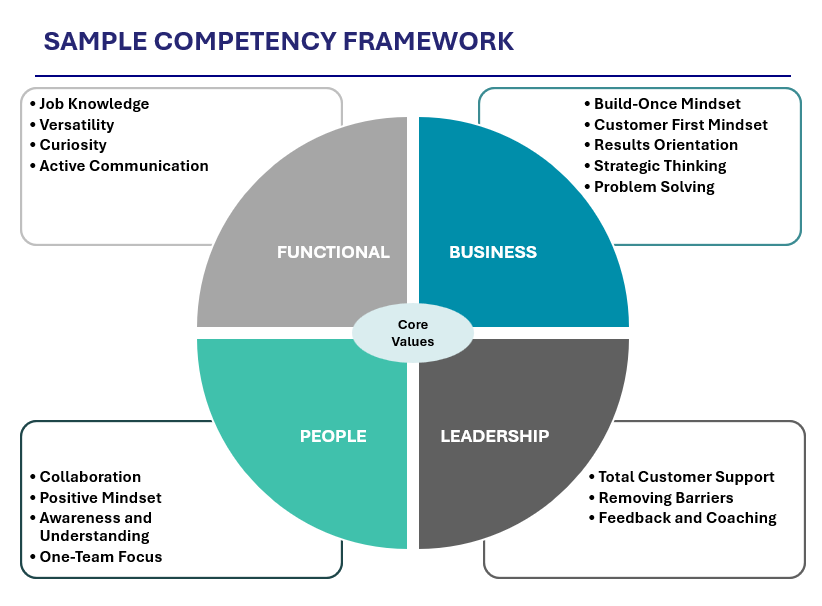
Importantly, competencies aren't a one-and-done solution. Unfortunately, words on a page and put in an electronic folder won't spark transformational results. We often find that organizations start with a competency model for performance reviews or assessment, but neglect to thread it throughout the entirety of operations and the employee experience. This is a missed opportunity not only for performance and culture, but also for building diversity, equity, and inclusion.
Competency Model Examples: From Organization-Wide Frameworks to Role-Specific Models
Competency frameworks range from organization-wide models that define shared expectations across every role to targeted models built for specific job groups. The framework above illustrates an organization-wide approach — four categories spanning Functional, Business, People, and Leadership competencies. Below are examples at the leadership and frontline levels.
Leadership Competency Models
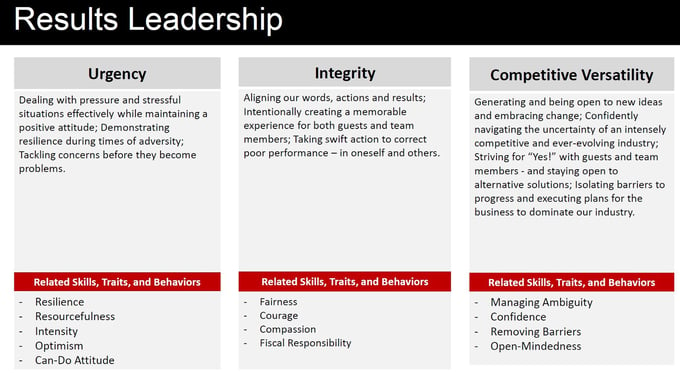
Leadership competencies define how managers and senior leaders drive results, develop their teams, and steward the organization's culture. The sample leadership competencies discussed later in this post — including Feedback and Coaching, Removing Barriers, and Total Customer Support — illustrate how leadership behaviors can be clearly defined and measured. For another example, see how emotional intelligence functions as a leadership competency in healthcare settings.
Frontline and Restaurant Competency Models
For frontline roles, competency models focus on the specific behaviors that drive guest experience, team collaboration, and operational consistency. Explore how individual competencies work at the frontline level: Positive Mindset and Resilience and Cognitive Ability each play distinct roles in a restaurant front-of-house competency model. For a broader look at how competency-aligned assessments apply to restaurant leadership, see Hiring the Best: Validated Assessments for Restaurant Leadership. For a role-specific example, see the seven competencies great restaurant managers share.
Start building meaningful competencies for your organization. Access our resource kit.
Threading Competencies Through the Employee Experience
Now, what does it mean to connect a competency model to the employee experience and operations? This might seem strange if you've seen a competency framework or model that seemed overly technical and removed from your day-to-day. How exactly would that become a useful part of how you work?
- First, communicate in language employees understand. While some of us might love to geek out on words like conscientiousness and interpersonal helping, will those phrases carry the same meaning to all employees; let alone earn their interest and shared understanding of what we're working towards? You may have different versions or materials for specific use cases. Detailed documentation may include more background while a version that's used for leadership development may only include pieces.
- Name it. What if your competency model, or organization-wide framework, had a name that connected it to your culture, vision, and operations? This captures the attention of your employees and gives forward momentum to both your culture (at the center of the organization-wide framework above) and the competencies.
For our team at Corvirtus, our competency model is called the Remarkable Growth Blueprint, enforcing our mission and vision of building remarkable places to work as well as emphasizing positive growth and flourishing for everyone. - Action sessions. When launching your competencies, or looking to thread them throughout the employee experience, bring all stakeholders together to agree on how the competencies can be maximized for a set purpose. Action meetings could be held for interviewing, day-to-day coaching, performance improvement, and more. You could also have challenge-focused action sessions. These teams might focus on how your competencies can drive retention, productivity, and results, and key outcomes specific to diversity, equity, and inclusion.
By connecting competencies with the systems that drive diversity and inclusion goals, like performance management, selection and promotion, and the employee experience, we can evaluate and develop people based on their ability to contribute, minimizing obstacles to diversity and inclusivity in the process.
How Competency Models Drive Diversity, Equity, and Inclusion
Any goal, including any for DEI, will struggle if not planted in an environment that allows it to be embraced. If we're seeking to build diverse, equitable, and inclusive teams, envisioning what performance looks like is key. Competencies communicate the how of your culture and the path to the bright ambitious vision you're seeking to achieve. When we clearly communicate, coach, and celebrate accomplishments within how we've defined performance, we're focusing attention and energy on what it means to be a part of our team.
In fact, my team and I started thinking about this because of several conversations with operational and HR leaders where they shared the desire to continue to support DEI in a way that could gain shared support and commitment. As we talked we learned their organizations were struggling to find a way to do this but were also lacking competencies.
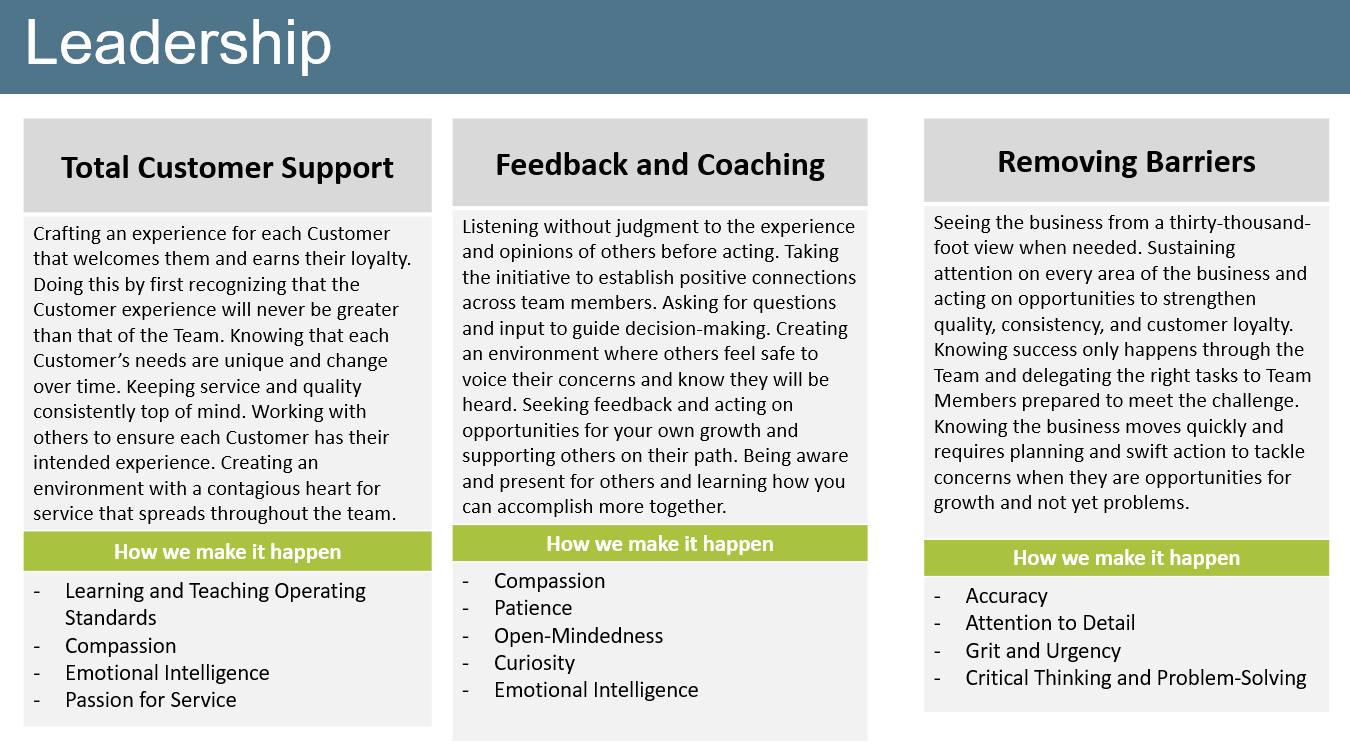
Competency models, when connected to the fabric of your operations, can work to focus attention on performance and while doing so create an environment that welcomes differences in service of your greater goals and performance (that are now well defined). They help us see gaps in performance and vulnerabilities we didn't recognize before. Take sample leadership competencies shown above. For leaders in positions living and contributing within this competency model, these three sample competencies bring forward expected behaviors that define taking care of customers, collaborating, and removing barriers to success.
If we look at Removing Barriers, one of the actions is seeing the business from a thirty-thousand-foot view. Feedback and Coaching emphasize psychological safety, seeking feedback, and listening. Even Total Customer Support references compassion and that the Customer's experience is never greater than the team's experience.
Clearly communicating what performance looks like also broadens opportunities for all employees across backgrounds. When employees know the behaviors, knowledge, standards, and criteria to which they are evaluated, they are better equipped and positioned to ask questions and seek out experiences that will nurture their growth.
Importantly, the how of diversity and inclusion can be woven into existing competencies. In this way you're communicating their importance in ways that are practical and that employees and leaders can see the value of delivering.
Competency models can also help to identify and address any biases that may exist within the organization. By defining inclusive behaviors as competencies, organizations can encourage employees to engage in behaviors that promote diversity and inclusion and discourage behaviors that may perpetuate bias or exclusion.
Furthermore, competency models can be used to guide recruitment and hiring processes. By including diversity and inclusion as competencies, organizations can ensure that they are actively seeking candidates who possess these qualities.
Build a blueprint for your team. Access resources for building and applying competencies.
As we're also working within a cost-conscious environment, building or improving upon how you're maximizing competencies will address a myriad of challenges you might be facing. Bayer, for example, recently shared with the Wall Street Journal how self-led teams are central to profitability for the company. While this concept isn't new, certainly defining and then building a shared understanding of the what and how of performance will support any company exploring new ways of working, as well as fairness and inclusivity in those environments.
Overall, competency models provide a structured approach to promoting diversity and inclusion within organizations by establishing clear expectations and guidelines for behavior.
Competency models support organizations in creating an inclusive work environment by providing a framework for defining and measuring inclusive behaviors. By clearly outlining the competencies required for inclusivity, we can set expectations for all employees and create a common understanding of what it means to be inclusive.
Competencies can also be used to develop training programs that promote inclusivity. For example, we've worked with organizations to build development assessments and experiences that support growth guided by their unique competencies. Participants received feedback both from a self-focused psychometric assessment and performance feedback on potential strengths and vulnerabilities and then met with others over six months as they explored their own growth journeys together.
Competency models can be used to assess inclusive behaviors. By defining the behaviors that nurture inclusive and diverse teams, they can be assessed through performance management. By using competency models as a measurement tool, organizations can ensure that performance evaluations and development plans are aligned to create an inclusive workplace where everyone feels a sense of belonging.
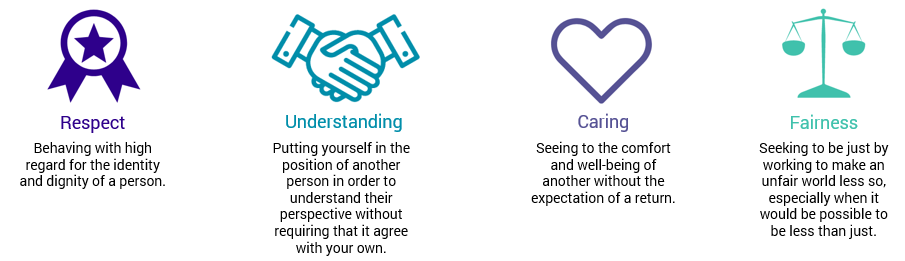
In addition, by knowing and measuring the specific behaviors and skills associated with inclusivity, and where their gaps exist, teams can design targeted training initiatives to support employee development precisely where it is needed to create teams that embody respect, understanding, caring, and fairness — the four cornerstones for a flourishing team.
Overall, competency models provide a roadmap for organizations to create and sustain an inclusive work environment by defining, measuring, and rewarding inclusive behaviors.
Measuring performance and inclusivity with competency models allows organizations to identify areas for improvement, provide targeted feedback and coaching, and recognize and reward individuals and teams that excel in these areas.
Connecting Competency Models Across the Employee Experience
When competencies are embedded across the employee experience — from how you select people to how you develop, evaluate, and advance them — they stop being a document and start functioning as a system. One of the most consequential connection points is hiring. When competencies define what success looks like, the next question is how to identify those qualities before someone joins. This is where competency models connect directly to competency-based hiring — and where the assessment decision becomes consequential.
A competency model tells you what to look for. A validated hiring assessment tells you whether a candidate has it. Without that bridge, hiring decisions default to intuition, unstructured interviews, and the kind of pattern-matching that introduces bias rather than reducing it.
The connection works in both directions. Competencies inform what an assessment should measure — not generic traits, but the specific clusters of knowledge, skill, ability, and mindset that drive performance in your roles and your culture. And assessment results, in turn, validate whether your competency model is actually predicting what matters. When candidates who score well on competency-aligned assessments go on to perform, stay, and contribute, you have evidence that both the model and the measurement are working.
This is also where realistic job previews earn their place. When competencies are clearly defined, a realistic job preview can communicate what the role genuinely requires — the pace, the decisions, the interactions — so candidates are choosing your organization with clear eyes. The people who move forward are more likely to stay because they understood what they were signing up for.
For organizations already using competency models for performance management or development, extending them to hiring creates consistency across the employee lifecycle. The same framework that guides how you evaluate and develop people also guides how you select them. Interview guides built around your competencies give hiring managers structured questions tied to the behaviors that actually matter, rather than a list of generic prompts.
Choosing the right assessment provider matters here. The questions worth asking — about assessment types, validation methodology, candidate experience, and legal defensibility — are ultimately questions about whether the provider's approach aligns with your competency framework. We've outlined eight questions that help distinguish a real partner from a polished presentation.
The result is a system where competencies aren't just a document — they're the through-line connecting who you hire, how you onboard and develop them, how you evaluate performance, and how you build the inclusive, high-performing teams the rest of this post describes.
Building and Improving Your Competency Framework
Defining and building a shared understanding of performance expectations gives you a multitude of opportunities for continuous improvement in quantifiable ways. Through regular evaluation of data around your competencies, leaders can identify areas for improvement and implement targeted strategies to enhance inclusivity and performance.
Competency models can also serve as a guide for creating organization-wide development plans that address specific areas of growth. By identifying competencies related to diversity, equity, inclusion, and belonging, organizations can design development initiatives that support individuals in acquiring and strengthening these skills.
Furthermore, competency models can be used to track progress and measure the impact of diversity and inclusion initiatives. By regularly assessing competencies, organizations can evaluate the effectiveness of their strategies and make adjustments as needed to drive continuous improvement.
In short, sometimes the simplest solution has the greatest impact. Competencies serve as the foundational building blocks for both business success and building flourishing, diverse, inclusive, and equitable teams. They provide a common language and understanding of performance expectations, guiding individuals and teams toward shared goals. By maximizing competency models that are tailored to specific job functions and overarching organizational frameworks, we not only establish clarity on how to excel but also empower individuals with the necessary tools to cultivate self-awareness and drive diversity, inclusion, and overall team success.
These competency models act as a compass, guiding individuals on the path toward continuous improvement and growth. Through regular assessment and evaluation of competencies, leaders can pinpoint areas for enhancement and implement targeted strategies to foster inclusivity and performance excellence. By incorporating diversity, equity, inclusion, and belonging competencies into organization-wide development plans, we can ensure that every individual has the opportunity to develop and strengthen these critical skills.
Moreover, competency models enable organizations to track progress and measure the impact of their diversity and inclusion initiatives. By consistently evaluating competencies, organizations can gauge the effectiveness of their strategies and make necessary adjustments to drive ongoing improvement. Ultimately, competencies not only facilitate a shared understanding of performance but also provide individuals with the essential resources to contribute to the creation of diverse, inclusive, and thriving teams.
Frequently Asked Questions About Competency Models
What is a competency model?
A competency model defines the specific clusters of skills, knowledge, mindsets, and behaviors required for success in a particular role or job family. It gives organizations a shared, behavior-based language for what performance looks like — making expectations concrete rather than assumed.
What is the difference between a competency framework and a competency model?
A competency framework is organization-wide. It anchors your culture and enterprise priorities across every role, typically organized into broad categories such as Functional, Business, People, and Leadership competencies. A competency model is more targeted — it defines the behaviors and skills required for a specific role or job group. Frameworks and models are most effective when used together: the framework sets the shared foundation, and role-specific models translate it into day-to-day expectations.
How do competency models support diversity, equity, inclusion, and belonging?
By making performance expectations explicit and observable, competency models reduce reliance on informal norms and unspoken rules. This clarity lowers barriers for employees who may not have the same access to tacit knowledge or dominant cultural cues. When inclusive behaviors are defined as competencies, they become measurable and coachable — part of how work gets done, not a separate initiative.
How do you embed competencies across the employee experience?
Competencies deliver the most value when they are threaded through hiring, onboarding, performance management, development, and succession planning — not parked in a folder after an annual review. Practical steps include communicating competencies in language employees understand, giving your framework a name that connects to your culture, and holding action sessions where stakeholders align on how to apply competencies to specific challenges.
How do competency models connect to hiring assessments?
A competency model tells you what to look for in candidates. A validated hiring assessment tells you whether a candidate has it. When assessments are aligned to your competency model, hiring decisions are grounded in the same behaviors and standards used for development and performance evaluation — creating consistency across the employee lifecycle.