
A manager sees a leader’s results. The team sees how she gets them.

Short Version
When change makes the leaders you already have more important, the real question is how well you know how they lead. A manager sees results and an hour or two a week. The team sees the rest. A 360 asks them. Use one when the question is how someone leads today, wait when nobody will act on it, and plan what happens afterward before anyone answers.
Fewer people are leaving their jobs, and fewer are being hired. In a low-hire, low-fire labor market, the leaders a company has now are the ones it will rely on through whatever comes next.
That raises a harder question than who’s on the shortlist. Do you know how your leaders lead when you’re not in the room?
Your regional leader knows the numbers. Your CHRO knows the talent review. Neither is standing beside that manager when a shift falls apart, a customer escalates, or a high performer needs difficult feedback.
A manager sees a leader for an hour or two a week. Her team sees her for the other 40. On the Friday rush. In the hard conversation. When the schedule falls apart.
And the shortlist only covers some of the people. The bench is everyone already leading something. Uncertainty tests whether leadership runs deep through an organization or sits with a few names at the top of a list.
What Are You Missing About Your Leaders?
The higher someone rises, the easier it is to see her results. It gets harder to see the everyday behavior producing them.
Most organizations have these leaders:
- The one who always looks polished in the executive meeting may be creating confusion downstream.
- The manager everyone describes as “nice” may be avoiding the conversations her team needs her to have.
- The high performer everyone assumes is ready for more may be getting results partly because her team works around her.
- The quiet leader who rarely comes up in talent reviews may already have the trust and followership you’re trying to build elsewhere.
Uncertainty brings this behavior to the surface. It shows how someone communicates when she doesn’t have all the answers. It shows what happens on her team when priorities change, whether people trust her under pressure, and whether problems come up early or late.
Leaders know their manager is watching. Direct reports see what happens when the manager isn’t.
What Do Different Raters Actually See?
Each group sees part of how someone leads. None of them sees all of it.
| Rater group | Sees best | Can’t see |
|---|---|---|
| Direct reports | Day-to-day leadership: coaching, fairness, how mistakes get handled | Results, and what her own boss asks of her |
| Peers | Collaboration, sharing information, keeping commitments | How she runs her own team |
| Her manager | Results, judgment, how she handles the business | Most of the working week |
| Customers or clients (optional) | Service and follow-through | How the team works when they’re not there |
| Herself | Intent and effort | How it lands on others |
That’s why a 360 asks all of them.

When Is a 360 the Right Way to Find Out?
A 360 answers one question well: what is it like to be led by this person today? So start with the question you need answered, then choose the tool.
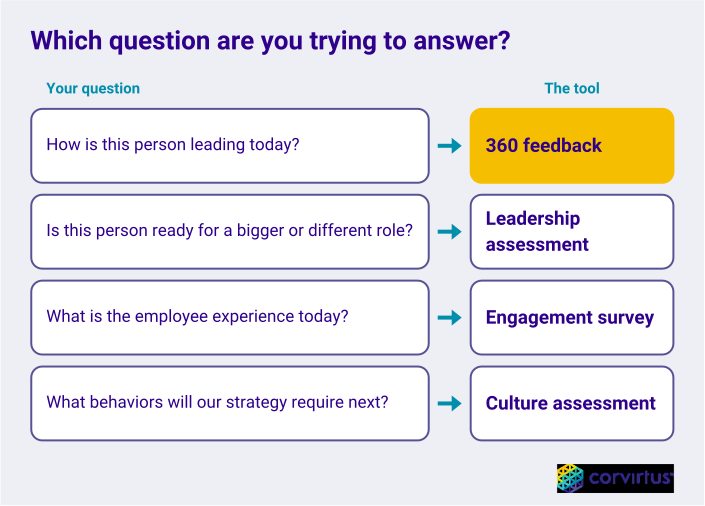
I’ll be candid about promotions. A 360 can inform a promotion decision. On its own, it can’t tell you whether someone is ready for the next seat. A leadership assessment built around that role answers it better.
Sometimes the right answer is to wait.
| Don’t run a 360 when… | What happens | Do this instead |
|---|---|---|
| Nobody will act on it | People stop answering candidly | Wait until there’s room to follow through. See before you run a culture survey |
| The team has just lost faith in the leader | The 360 records the anger, not the leader | Deal with what happened first. Run it when people are calmer |
| The only question is the next promotion | A 360 reads the job someone has now | Start with a leadership assessment built around the next role |
| It’s your busiest season | Leaders have no time, and the answers reflect the rush | Settle the question and the raters now. Launch when it eases |
If you’re heading into peak season, plan the 360 now and launch it when your leaders have the bandwidth to take part thoughtfully and act on what they learn.
Learn more about what a leadership assessment tool tells you.
What Has to Happen Afterward for It to Matter?
A 360 is where the work starts. Four things decide whether it changes how someone leads.
Choose raters together. The person and their leader pick raters jointly, so neither side stacks the list. Every rater should see the leader often enough to answer.
Say who sees the report. People who don’t know who will read their feedback answer guardedly. Generally it’s the person, their supervisor and HR. Tell everyone before anyone answers.
Debrief first. A report handed over cold gets defended and filed. The person reads it first in a one-on-one, ideally with a third party, then talks it through with their supervisor. When a whole leadership team goes through it together, as the leadership team at Goodwill of Colorado did with us, the debrief can surface what nobody says at the table.
Put something behind every goal. Name the behaviors each goal needs and the touchpoints that will support them: check-ins, team conversations, sessions and personalized nudges. That’s how a 360 becomes the starting point of a Growth Journey™. A goal with nothing behind it is the most common way a 360 goes to waste.
Then, once there’s been time for change to show, ask again. The test is whether the people around her experience it.
Learn more about employee development plans that stick.
Ask the People Who Know
When the future is uncertain, your leadership bench matters more, not less.
You probably already know who delivers the numbers. The question is whether you know what it’s like to be led by them.
Their teams do.
Ask them. Then make the answer matter.
Cover Photo by Carson Vara on Unsplash
Frequently Asked Questions About 360-Degree Feedback
What can 360 feedback tell you that a manager’s review can’t?
A manager’s review sees results and the hour or two a week they spend together. A 360 adds the people who see the rest: direct reports, peers and sometimes customers. Each sees a different part of how someone leads.
Who should a company ask to rate a leader in a 360?
Anyone who works with the leader closely enough to answer: direct reports, peers, her own manager and sometimes customers. The person and their leader choose raters together, so neither side stacks the list.
Can a 360 show whether someone is ready to be promoted at a company?
Not on its own. A 360 reads how someone leads in the job she has now. A leadership assessment built around the next role answers readiness better, and we use the two together.
How often should a company run 360 feedback?
Don’t rerun a 360 until there has been enough time to act on the first one. In between, track progress on the behaviors through regular check-ins, then use another full 360 to see whether others experience the change.
Who sees the results of a 360?
Generally the person, their supervisor and HR. Decide before anyone answers and tell the raters, because people who don’t know who will read their feedback answer more guardedly.
What are the disadvantages of 360 feedback for leaders?
It takes real time from raters, it records the mood of the moment, and it’s confidential but never fully anonymous. It also reads only the job someone has now. The section on when to wait covers each one.