
The year ahead is uncertain. Where your people stand doesn’t have to be.

Tight merit budgets leave little room to reward meaningful differences in performance.
Median merit budgets are sitting at three percent for the second year in a row. Take two employees at $75,000. The solid performer receives a three percent raise. The high performer earns five and a half percent.
The math doesn't give us much: the difference is $72 a paycheck.
That’s asking $72 to carry an awful lot of information about what someone’s year meant. Salary.com, which ran the numbers, calls the margin for rewarding top performers “remarkably thin.”
So if pay can’t tell your strongest people apart, what does?
Performance feedback, or a calendared performance review, earns credibility when something happens because of it.
A development investment.
A stretch assignment.
A career growth or succession conversation.
Recognition specific enough to mean something.
First shot at the next opportunity. Even an honest explanation of why the raise coming at the end of a year of strong contributions falls short.
When nothing happens, employees learn something too: the review was paperwork.
And they’re watching more than the number at the top of the form. Often the most important part of the review process is that it's viewed as fair and accurate. Employees, especially top performers, judge whether they had a voice and understand how the organization reached its decision.
Leaders teach employees whether their reviews are worth believing, mostly through what happens after the review is finished. That’s worth getting right before another year begins.
Short Version
Is your performance review worth believing?
A performance review earns credibility in two ways: the rating has to be trustworthy, and something meaningful has to happen because of it.
Before another review cycle begins, ask:
- Are the ratings accurate? Ratings should reflect performance against a shared standard, not an outcome a manager has already decided on.
- Would the same performance earn roughly the same rating from a different manager? If not, manager habits may be driving the score more than actual performance.
- Does anyone look across ratings and challenge what doesn’t make sense? Calibration matters, especially when reviews influence pay, development, succession, or opportunity.
- Can employees understand what happened? They should be able to see how performance, their rating, their standing, and their raise connect, including why those things may not align perfectly.
- Does anything happen because of the review? Strong performance should lead somewhere: recognition, development, stretch assignments, succession conversations, career opportunities, or at minimum an honest conversation about what comes next.
- Do the reviews tell leadership something useful? A year of review data should reveal more than individual scores. It should show where talent is strong, where managers disagree about performance, where development is needed, and where the organization may be carrying risk into the next year.
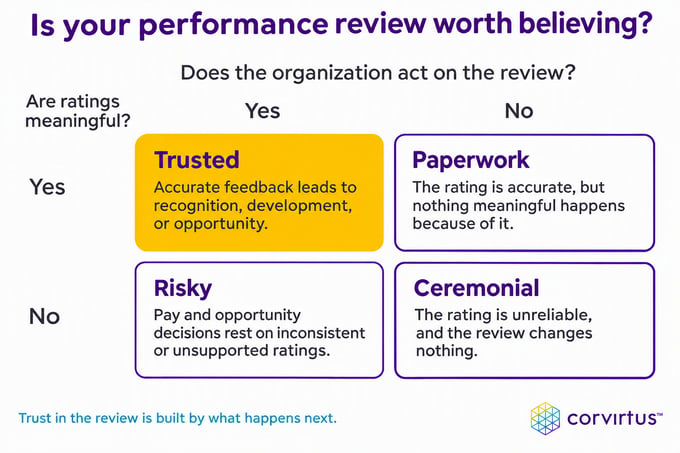
Does a performance rating of 'five' meaningfully different from a 'three'?
If your strongest performer and your middling one end the year the same way, what was the purpose of the review?
A review exists to drive performance and development. How much money is available is a separate question.
The highest rating doesn’t automatically earn a big raise. Budgets are real. Pay bands, internal equity and market position are real. Some years there simply isn’t much money to differentiate.
That happens. Then something else has to communicate to your strongest performers their performance mattered.
If the consistently strong performers (the 'fives') receive the same response from the organization as average contributors (the 'threes'), people stop caring much which one they receive. People recognize ceremonial paperwork quickly.
Are Your Managers Rating Performance, or Working Backward From an Answer?
The thinking goes something like this: “Jane really should be in the 2% group, so I’ll write the review that puts her there.”
That’s starting with the answer and working backward.
Raters deserve attention too. In one large study of managers’ performance ratings, rater effects explained substantially more of the variation in ratings than the performance of the person being rated. A rating can tell you something about the manager as well as the employee.
That makes the standard and the process key. Excellent can’t mean one thing to one manager and something else three departments over. Whether the standard is customer leadership, problem solving, safety, or developing others, employees deserve to be measured against a shared definition of what the role requires, not against whoever happens to sit beside them.
Find out how competency frameworks are the first step in solving this problem.
Reviews are built and run through these standards. Where they land, they land.
My team and I build performance review systems so leaders work through the evidence before arriving at an overall rating. We start by defining what good performance looks like in the role, then translate those expectations into specific, observable behaviors. Managers evaluate performance against those standards, competency by competency, rather than choosing an overall score and finding examples to defend it.
The overall rating should summarize those judgments, not dictate them. That gives leaders something concrete to explain and employees something useful to act on: where their performance meets the standard, where it falls short, and what improvement requires.
Someone Has to Be Willing to Say, “That Rating Doesn’t Look Right.”
Here’s a question I like to ask leadership teams: what behaviors differentiate average performers from strong performers?
When the first round of reviews are complete, do the averages and overall ratings match contribution?
No one is asking senior leaders to wander the halls overruling manager reviews. But someone needs a view across teams before ratings reach employees. That’s why calibration, between rating and the teams receiving their reviews, is critical. Do the labels mean roughly the same thing from one department to the next? Does the evidence support them? Is one manager giving almost everyone exceptional ratings while another seems to believe excellence is a precious natural resource?
This also sets an expectation for leaders: performance reviews matter, their judgments will be discussed, and they need to explain the evidence behind them. Those conversations help build a culture where giving feedback, asking questions and reconsidering a judgment are part of the work, not signs that something has gone wrong. Leaders need to practice that openness with one another if they expect it from their teams.
When leaders check ratings against the evidence, they reinforce a shared standard for performance. When ratings go unexamined, the organization leaves that standard to each manager’s interpretation.

One Performance Conversation. Three Distinct Numbers.
Most performance reviews marry three questions into one meeting:
- Ratings: How did I perform against the standard?
- Tiers: Where does that place me relative to others, or within the performance structure?
- The raise: What does this mean for my compensation?
Collapse them and an employee can easily hear, “I received a two percent raise....but I'm not sure where I'm at — or where I'm headed."
Employees shouldn’t have to reverse-engineer meaning around their performance. Building a performance review process where employees must give their own feedback and perceptions makes all the difference.
To this point, a meta-analysis spanning 27 studies found participation strongly related to how employees react to their reviews. Having a meaningful voice in the process mattered more than participation aimed at changing the outcome.
A voice isn’t a veto. People may still dislike the rating or wish the raise were larger. People can accept an outcome they dislike. An opaque process is what costs credibility.
This might mean insisting on self-evaluations for everyone. It may mean leadership training for supervisors on how to involve employees in their review conversations. A quick 'how'd it go?' survey to benchmark how the review cycle went and compare to last time could also help.
Employees need to see beyond the numbers to view understand their performance in context. Here's what happened, here's where we're going, and this is what it means for your compensation right now.
Like your manager, like your performance review?
In short, forms, rating scales and competencies matter. But not as much as the person sitting across the table.
Another large meta-analysis found reviews ride or die on the relationship between the employee and their manager. The quality of the supervisor-employee relationship influenced reactions more than the ratings themselves. Ultimately, if what's said in the meeting is a surprise, or not grounded in trust and psychological safety, no process, software, or training matters. Even the ability of compensation to motivate and lift performance is limited.
Customers feel the difference too: a team that trusts its reviews is a team that knows what good service looks like.
Repeatedly chasing a manager to complete performance reviews reveals more than a missed deadline. In my work, the leaders who require the most follow-up are often the same leaders who do not stay with the organization long term. Now, that is an observation from practice, not a research finding or a basis for predicting who will leave.
But the responsibility is clear: observe performance, evaluate it against shared standards, explain the judgment and follow through on development. When a manager postpones that work quarter after quarter, employees and leaders receive a different message: accountability is optional.
Learn more about what a leadership assessment tool tells you.
Your Reviews Should Tell You Something About Next Year
A year of performance reviews, whether quarterly, twice a year, or annual, is organizational data. Unfortunately, most companies barely use it.
Step back from the individual forms and questions emerge.
-
Where are the competency gaps?
-
Where is the bench thin?
-
Which managers consistently rate differently from everyone else?
-
Where should development dollars go?
-
Connected with engagement and turnover data, what patterns show up before people leave?
- I could keep going.
At one manufacturing organization we worked with, performance data consistently pointed to gaps in teamwork and a service mindset toward colleagues. Technical skill was generally strong. The harder problem was the quality of working relationships across departments.
Leadership combined the performance feedback with individual assessment results and a baseline CultureMap survey process to examine the gaps from both individual and organizational perspectives. In the following quarters, we charted stronger cohesion across departments alongside higher performance ratings.
The value extended beyond higher scores. Leadership had used performance data to identify specific development needs: teamwork and service to colleagues across departments.
Accountability applies to the organization, too. Development investments should address the gaps reviews uncover. Stretch assignments and succession conversations should reflect demonstrated strengths and readiness for greater responsibility. When employees can see those connections, they have evidence that the review informs talent decisions rather than simply documenting performance.
Learn more about employee development plans that stick.
Before You Redesign the Process
If leadership can’t explain what the review process is supposed to accomplish or what good performance looks like, it's not the time to build another survey or rating rubric. A better form can’t solve an unanswered question.
Performance reviews employees trust start with two decisions:
-
What is the purpose of the review?
-
What are we measuring and what does performance look like?
Decide what the review is for. Set the standard. Then look at the process.
And through all of this keep in mind that the review is not the answer. It's what happens after the review. If the process can spark conversations, earn trust, inspire, and direct attention to blind spots we're setting our teams up for success. This means goal-setting, consistent communication, and commitment by leaders who build trust. Our own research on retention and development finds that employees who receive goal-specific feedback at least twice a month are five times more likely to report top-box engagement and greater intention to stay.
Trusted Beats Perfect
A performance review doesn’t need to promise a raise. It doesn’t need to make every employee happy. And it certainly doesn’t need another eighteen-box form.
It simply needs to be trusted.
When we don't have to guess what good performance looks like, where we fall against the standard, and what is going to come next, our minds can focus on the task ahead.
A year of performance conversations should leave leadership with more than proof that everyone had one. It should show which capabilities are consistently demonstrated, where managers have developed their own definitions of “excellent,” which competency gaps limit performance and where development investment belongs.
You can’t remove every uncertainty from the year ahead. But your people shouldn’t have to guess how they’re performing or what happens next.
Before the next review cycle, check whether your process gives them evidence they can trust, not just a rating they’re expected to accept.
Frequently Asked Questions About Performance Reviews
Why don’t employees trust performance reviews?
Because what happens after the review doesn’t match what the review said. Trust also breaks down when employees can’t see how a rating was reached, or when managers apply the standard differently. A review earns trust when the organization acts on it.
Should performance reviews be tied to raises?
They should connect, but they aren’t the same decision. A review measures performance and development; a raise also reflects budget, pay bands, internal equity and the market. Say up front how the two connect, and when pay can’t separate strong performers, use development, opportunity and recognition.
How should a manager explain a raise that doesn’t match the performance rating?
By separating the two decisions out loud. The rating says how the person performed against the standard; the raise reflects budget, pay bands and equity. Name both, say which constraint set the number, and say what else the organization is doing to recognize strong performance.
How often should employees get performance feedback?
Continuously, with a formal review on top. Goal-specific feedback at least twice a month is a good floor. Employees shouldn’t have to wait for the annual review to learn how they’re doing, and nothing important should appear for the first time in it.
What should a leader do when a manager’s rating looks wrong?
Check whether the evidence supports it and whether the same performance would get the same rating elsewhere in the organization. If it needs to change, change it through the manager, not around them, so the manager still owns the explanation.
What can a year of performance reviews tell leadership?
Where the competency gaps are, where the bench is thin, which managers rate differently from everyone else, and where development dollars should go. Connected with engagement and turnover data, reviews can also show patterns before people leave.