
Why do some employee development plans stick while most are forgotten?
Quick answer: An employee development plan is a roadmap for helping employees build the skills and behaviors their next role will require. But, clearly, a document alone rarely changes behavior.
Organizations that consistently build strong leaders do something different: they support growth with consistent touchpoints that support the tough stuff of behavior change. They combine validated assessments, coaching, reinforcement through nudging , and accountability into scalable development systems. At Corvirtus, we call that system the Growth Journey.
An employee development plan should exist as part of the journey. It is not the journey itself.
Why Behavior Change Is Harder Than It Looks
If development were as simple as creating a plan, we'd all have healthier habits, better managers, and more future-ready leaders. Unfortunately, behavior change is hard. Research on organizational transformation has long found that roughly 70 percent of major change efforts fall short of their objectives, and individual behavior-change efforts usually fare worse. People rarely change because they gain information. They change when new behaviors are supported, practiced, coached, measured, and sustained over time. That's the mistake most employee development plans make. The plan isn't wrong; it's incomplete. Insight alone rarely changes behavior.
Growth doesn't happen because someone has potential
"Who are your future leaders?"
Most executive teams can answer that question in seconds.
Ask what those future leaders are actively working on this month to prepare for larger responsibilities, and the room often gets much quieter.
That's because identifying potential and developing potential are fundamentally different activities.
An employee development plan is not simply a document that identifies future leaders. It's a system that helps employees build the behaviors their future success will require.
Organizations often spend significant time discussing talent and surprisingly little time creating ongoing development touchpoints.
The result?
Development becomes something employees talk about during performance reviews rather than something they actively experience.
We recently worked with a healthcare organization where every leader, not just those identified as high-potential, owns a development plan supported by a consistent rhythm of coaching conversations, developmental assignments, self-reflection, and accountability.
Development isn't something that happens once or twice a year. In fact, our employee engagement and retention studies find that employees who receive goal-specific performance feedback at least twice a month are five times more likely to endorse TopBox (i.e., the highest rating on the scale) levels of engagement and intentions to stay.
Teams thrive when feedback is built into the employee experience.
That's the difference between growth that sticks and growth that gets postponed until next quarter.
See where your people are ready to grow. Start with a complimentary leadership profile.
Why most employee development plans fail
Most employee development plans don't fail because employees lack motivation.
They fail because development is treated as an event rather than a process.
A familiar pattern looks like this:
- Complete an assessment—could be a regularly scheduled performance review, or a chosen assessment.
- Build a development plan based on what we learned.
- Discuss it during a review meeting.
- Move on to other priorities.
Okay, on paper, that looks like development.
In reality, it creates awareness, but not behavioral change
Despite how convenient it would be otherwise, research on learning and performance consistently demonstrates that information alone rarely produces lasting behavior change. People may understand what they need to improve, yet still struggle to act consistently without reinforcement, feedback, and accountability.
The problem is not the plan.
The problem is what happens after the plan.
Or more accurately, what doesn't.
Development stalls when there are:
- Too few coaching conversations
- Too few opportunities for practice
- Too little accountability
- Too little feedback
- Too little reinforcement
A development plan without ongoing intentional touchpoints is similar to a sales goal without strategy.
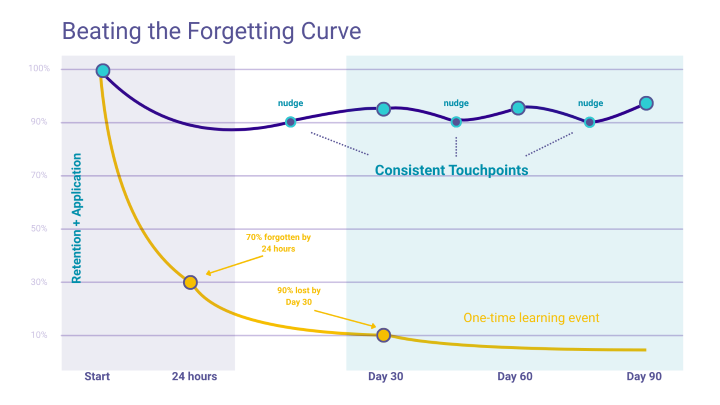
The intention is there. The support needed behavior change isn't. We all face a steep forgetting curve, or inevitable loss of of information and energy, following any momentary learning or touchpoint.
Organizations that see meaningful growth create systems that keep development visible long after the planning meeting ends.
That's the foundation of what we've created with our Growth Journey Framework.
Employee development plans shouldn't be reserved for a select few
Many organizations concentrate development resources on a small group of employees identified as "high potential."
The intention makes sense. The risk is that development becomes a privilege rather than a process.
The reality is that future leaders don't always emerge from the people we initially expect. Growth often appears after employees receive opportunities, feedback, coaching, and support. Not before.
When development is reserved for only a handful of people, organizations limit their ability to discover hidden capability across the broader workforce.
The better approach is not to develop everyone identically. It is to give everyone in a role a clear development rhythm, then scale the depth of support based on nature of your organization, the role, and each person.
Our Growth Journey Framework is designed around that principle. It helps organizations create development rhythms across a role population instead of concentrating support only on a shortlist.
That matters because hidden capability often appears after people receive structured opportunities, coaching, and accountability. Development is not merely reward potential. Development reveals potential.
That's one reason the Growth Journey Framework focuses on building development rhythms across an entire role population rather than concentrating exclusively on a small talent shortlist.
Seeking to better understand your strengths and blind spots? Take our Personal Insight and Development Report — or share it with someone you want to support.
The list isn’t the plan – and it isn’t the whole story
“We have a list of high-potentials. What should we do next?” is the question we hear most, and it’s the right one – but the list is a smaller starting point than it looks. Naming potential feels like progress. On its own, it isn’t. A label sorts people; it doesn’t move them.
Most pipelines stop at the sorting:
- Run the 9-box talent grid.
- Mark the names in the top-right corner.
- Consider the work done.
The 9-box can create useful conversation, but it does not answer the development question. It tells you how people are currently viewed on performance and potential. It does not tell you what each person needs to practice, what support their manager should provide, or what evidence will show progress.
The better question is not only, "Who is on the list?"
The better question is, "What rhythm will help people in this role keep growing?"
That shift matters. You develop everyone in a role, not identically, but intentionally, because being developed is one of the clearest signals that the organization sees a future for them.
Turn your high-potential list into a development plan. Start with the people you can’t afford to lose. Explore Employee Development →
What are the benefits of developing every employee?
Developing everyone in a role, not just a labeled few, pays off in ways the list never will:
- Retention. Development is the clearest signal a company sees a future for you – people stay where they’re growing.
- Hidden capability surfaces. Focused, specific challenges reveal skills and range that broad training and a 9-box rating both miss.
- A real bench, not three names. You stop betting your future leadership on a shortlist you guessed at.
- Fewer promote-the-wrong-person misfires. When everyone is developing on the record, readiness is something you can see instead of assume.
- The customer feels it. Because the frontline is the customer experience, a developed team shows up as a better guest, resident, or patient experience – shift after shift.
That last point is where development reaches the P&L. It’s also where a lot of “development” quietly fails – which is the next problem to solve.
Why does readiness stall – and what does it cost?
Readiness still matters. It is just not the whole story. Readiness is evidence that a person can operate at the behaviors the next role requires. It is not the same as being excellent in the current role. Organizations often confuse those two questions. They promote strong performers and hope the next-level behaviors appear after the title changes.
When development is episodic – a workshop, an off-site, an annual review – people don’t visibly progress. So “ready” never gets built ahead of time; it gets asserted the moment a seat opens, usually on the strength of current performance. That’s a guess dressed up as a decision. And it’s expensive: nearly half of promoted people underperform for up to 18 months after stepping into a new role – mostly not competence failures, but readiness failures. It’s the exact pattern we've shared before: strong performers set up to struggle because no one built the next-level skills first.
A leadership readiness assessment turns that guess into an informed decision.
It does two things a title cannot:
- Shows whether someone can do the next job.
- If not, shows exactly what they’d need to get there.
That second part is the point. Readiness isn’t only a gate – it’s a map for the development that closes the gap.
Would you bet the shift on this promotion? A readiness assessment turns that bet into a decision. See our assessment approach for hiring, promotion, and beyond →
Employee development plans stick when development is consistent.
Development doesn't happen because someone attends training. Development happens because growth remains visible.
Again and again.
Over time (even when there's whirlwind of priorities pulling our focus away).
Research across leadership development, behavior change, and performance improvement points to the same conclusion: lasting change requires reinforcement.
People need opportunities to practice.
-
They need feedback.
-
They need coaching.
-
They need reminders.
-
And they need accountability.
The challenge isn't creating a development plan, but keeping development alive after the plan is written.
That's why the Growth Journey was designed around consistent developmental touchpoints.
Each touchpoint keeps growth visible and actionable.
Each touchpoint keeps growth visible and actionable:
• A validated assessment creates awareness.
• A manager coaching conversation creates direction.
• A self-reflection creates ownership.
• A stretch assignment creates practice.
• A nudge keeps the growth focus salient between formal conversations.
• A follow-up cadence creates accountability.
Over time, those touchpoints compound. The result is not simply better awareness. It is behavior change.
And behavior change is what ultimately creates readiness.
What blind spots are slowing your team down? Take our Personal Insight and Development Report.
What goes into an employee development plan?
A useful plan is simple enough to actually use and specific enough to guide action. It names both the destination and the behaviors to get there:
- A clear growth goal – stronger performance now, or readiness for a specific next role.
- The behaviors to build – named in observable terms (“give timely coaching feedback,” not “be a better communicator”).
- Why it matters – the tie to the person’s role, the team, and the customer.
- Specific actions – practice, feedback, and stretch assignments, not training alone.
- Manager support – how the leader will coach, open doors, and clear barriers.
- Progress measures – what’s visibly different when it’s working.
- A follow-up cadence – so the plan stays alive instead of going in a drawer.
Keep each person’s plan to one to three priorities. A development plan is not a personal-improvement landfill – focus is what makes it move.
Where do you put the most focus? Everyone in a role gets a plan and the rhythm behind it. The depth scales toward the people closest to a critical next role, or the ones showing the most range – more intensive coaching, bigger stretch. But everyone stays in the rhythm, because that’s what surfaces the capability a snapshot missed and keeps your whole bench – not just its top few names – from drifting out the side.
How do you build an employee development plan that sticks? The Growth Journey
A framework is a map. It tells you where “ready” is. It doesn’t walk anyone there. The walking is the Growth Journey – the part most development advice leaves as a to-do. We run it as an ongoing rhythm, and it comes down to three moves.
1. Awareness through assessment – clear direction. A carefully selected profile-based assessment shows how each person leads, where their strengths sit, and the one growth focus that matters most for their next step. We run it for a larger group, often everyone in role, not a shortlist, because you can’t reliably tell at the outset who will grow the most once support is consistent. This is also what settles “high-potential vs. high-performer” – the person who looks uneven today because she’s already reaching for tomorrow shows up here, where a performance snapshot would miss her.
2. Scaled coaching – make progress observable. Every four to eight weeks, we get together for scalable coaching. Participants are often placed in groups based on the ways of working or key areas for growth. My team and I meet with supervisors to review results so those closest to the participant is coaching the right thing at the right time. In the first meeting we review the assessments, any performance feedback (e.g., recent review), and evidence-based strategies for building that employee's development plan —which we often call a Growth Map. That’s how coaching reaches past the handful of people a senior leader can realistically mentor. Readiness stops being asserted when there's time and space and becomes something you watch being built.
3. Nudges – keep it salient. Between check-ins, employees are emailed, or texted, nudges and texts targeted to their own assessment results and goals. Development stays present in the ordinary weeks when nothing formal is on the calendar – which is exactly where episodic plans die. If I were participating I might here, "Hey Jennifer, remember your resilient leadership style? That comes with the tendency to take on too much too soon...."
None of this is a course you send a chosen few to. It’s a schedule of attention on the whole role, so the plan becomes a rhythm instead of a paper artifact. A promotion may come out of it – but the point was never the promotion. The point is people getting visibly, measurably better at their work. That’s what makes them stay, and what makes them ready when the moment comes.

Build the growth rhythm. See how assessment, coaching, and nudges fit together. See how development works →
What does a real employee development plan look like? A frontline example
Here’s a plan for a frontline manager in a service business getting ready for a multi-unit role:
- Goal: build the coaching and delegation skills a multi-unit role demands.
- Focus behaviors: give clearer feedback, delegate more consistently, hold the team accountable without bruising trust.
- Actions: hold one real coaching conversation a week; a quick feedback plan before hard conversations; a senior leader observes one shift and debriefs; a monthly look at turnover, guest comments, and shift execution.
- Manager support: a biweekly check-in built around real situations, not theory.
- Progress measures: steadier follow-through, fewer repeat issues, stronger team communication, clear signs of readiness for more.
Notice what makes it work: it’s specific, behavior-based, tied to the business, and it has a follow-up cadence. That’s the difference between a plan that looks good on paper and one that changes how someone leads.
Here’s the same shape as a template you can reuse:
| Section | What to include |
|---|---|
| Development goal | What the person is working toward |
| Business connection | Why this goal matters |
| Skills / behaviors | What to strengthen, in observable terms |
| Actions | What the person will actually do |
| Manager support | How you’ll coach and clear barriers |
| Resources | Assessments, tools, mentors, practice |
| Progress measures | How you’ll see it working |
| Follow-up cadence | When you’ll review and adjust |
Why this plan for growth holds up
We are not asking leaders to take development on faith. Several research streams point in the same direction:
- People stay where they’re growing. As recently as 2024 only about one in five organizations run an internal mobility program – most benches are thin because most people are never developed at all. The same research has long found that offering learning is a top retention driver, and that learners who set a specific goal engage about four times more than those who don’t. Aim is most of the work.
- Remarkable people are developed, not just born with technical brilliance. Google studied its own managers in Project Oxygen and found being a good coach tops the list of ten behaviors that define its best – while raw technical skill sits near the bottom, eighth of ten. Its follow-up, Project Aristotle, found how a team works together matters more than who’s on it, with the strongest teams beating targets by about 17%. Google turned both into a manager framework whose middle pillar is, literally, Develop People.
- Aimed development reaches the customer and the P&L. In a controlled study at a limited-service restaurant company, we compared matched restaurants—one group hiring and developing against a competency-based system, one without. The system group improved on 46 of 48 performance items, beat every other unit on guest-experience surveys, and grew comparable sales more than twice as fast as the control. Different sector from the bank, same pattern: measure the right behaviors, build them on purpose, and it shows up where the business keeps score.
- And the Growth Journey’s own results. One year post development participants were four times more likely to still be employed, rated 36 percent higher on performance reviews, and 87 percent of participants believed the program meaningfully supported their growth both within the role and personally.
Readiness is built, not found – for everyone, not a few
Think back to the healthcare group we opened with: every person on a growth plan, and check-ins that do not disappear when the week gets busy.
That is not a perk saved for a chosen few. It is how development becomes part of the operating rhythm. The high-potential list was never the employee development plan. It was the starting line.
Everything that turns potential into readiness happens after the list and across the whole role: an honest read on where each person stands, development aimed at the real gap, manager coaching, practice opportunities, nudges, and a cadence that keeps going when nothing formal is scheduled. Do that, and readiness stops being something leaders hope appears at promotion time.
It becomes something they watch being built.
That is the employee development plan most companies are missing. Not another form. Not another list. An intentional Growth Journey.
Turn potential into readiness. Start building your employee development plan →
FAQ
Should you develop everyone, or just your high-potentials? Strive for developing everyone—but not identically. You can’t tell at the outset who’ll grow the most, and offering development is one of the strongest things you can do for retention. Give the most intensive coaching and stretch to the people closest to a critical next role, but keep everyone in the rhythm – that’s what surfaces hidden capability and keeps your whole bench intact.
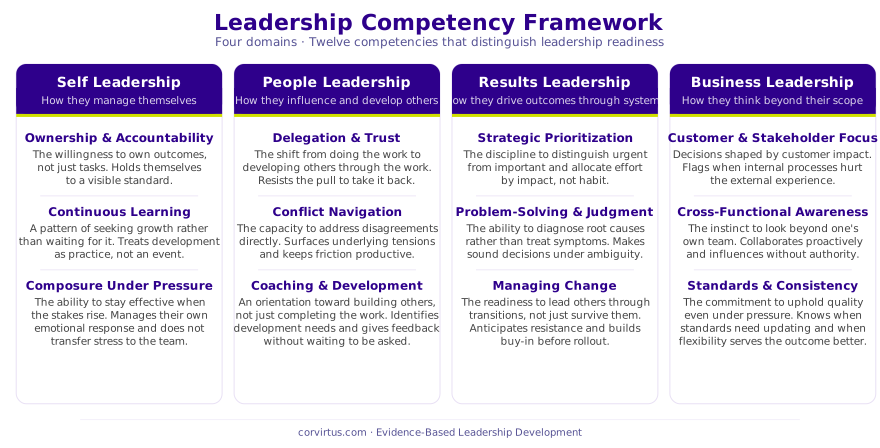
How do you create an employee development plan? Start from a competency framework – the observable behaviors that define success in the target role – then build the plan around the gap between where each person is and where that role requires them to be. Keep it continuous, not annual: a profile-based assessment up front, coaching on a set cadence, and personalized nudges in between. The framework aims it; the rhythm makes it stick.
What should an employee development plan include? A clear growth goal, the specific behaviors to build (in observable terms), why the goal matters, concrete actions, manager support, progress measures, and a follow-up cadence. One to three priorities, not a long wish list.
How often should you review it? Regularly – not once a year. A short monthly check-in with a deeper quarterly review works well, because development depends on attention. When managers revisit the plan, people keep practicing and connect growth to the work in front of them.
Who owns the plan – the employee or the manager? The employee owns it, but the manager makes it real by coaching, clearing barriers, and creating chances to practice. It’s a shared document, not a form HR files away.
What’s the difference between training and development? Training teaches a specific skill or process. Development is broader – it builds the capability, judgment, and readiness a person needs for what’s next. Training is an input; development is the growth you’re actually after.
What’s the difference between a high-potential and a high-performer? A high-performer excels at the job they hold today. A high-potential can succeed at a more demanding job they don’t hold yet – which can make them look uneven now, because they’re already reaching past their current role. Rewarding only current performance is how organizations promote the wrong person and overlook the right one.
Hero Photo by Imagine Buddy on Unsplash