
Choosing an off-the-shelf assessment for hiring or promotion because the label looks exciting is a bit like grabbing a mystery item from the menu and hoping for the best. You might get lucky, but probably not, and most demos will never show you the difference. We wrote these eight questions — and the answers behind them — because once the demos start sounding interchangeable, you need a practical way to separate a polished pitch from a hiring assessment product that will actually hold up in your operation. These eight questions cut through the sales theater and surface what actually matters: gaining predictive information and not a generic handbook, and in a way that delivers a strong candidate experience, provides legal defensibility, and supports the culture and vision of your business.
By the time you're reviewing hiring assessments providers, you likely heard a lot of the same already. They all talk about proof of product. They all say 'culture fit.' Everyone sports case studies with impressive numbers. The presentations blur together.
The question at this point isn't whether to use assessments. The question is how to tell the difference between a real partner and a polished presentation.
These eight questions help. They're the questions we'd want asked of us – and of anyone else in the room. Because the people this decision ultimately affects aren't watching a screen. They're on the floor, behind the counter, at the bedside, or intensely focused on a computer, waiting to work alongside whoever gets hired next. The hiring assessment a provider builds will shape who that person turns out to be.
In the Four Places your Leadership Pipeline Leaks Profit, we mapped the four-link service-to-profit chain where leadership quality flows through the employee experience to the customer experience to the bottom line. Then, in Hiring Assessments: 5 Signs Your Provider Understands Your Business, we laid out what a credible provider should be able to demonstrate. These eight questions are the tactical version — what to ask in the demo room and what the right answers sound like.
Part of our guide: How to Choose a Hiring Assessments Provider.
Hiring Assessments Require Eight "Yes!" Answers to These Questions
From our five decades working with organizations across industries, we have developed a suite of assessments that predict performance and results – supporting your teams in hiring to consistent standards and strengthening your culture. Delivering sound and full answers to each of the questions that follow is core to how we support the success of the organizations we serve.
1. Are your hiring assessments validated? What is your approach?
Validation is the word every provider uses. It's also the one most likely to mean different things in different rooms.
What it should mean: the assessment predicts actual job performance. Not only that the test items correlate with each other internally, but that people who score well go on to achieve intended metrics—they stay longer, perform at a higher level, protect the customer experience in the moments that matter. A validated assessment is the difference between a hire who reads a tough situation accurately and one who makes it worse.
A strong answer to this question includes specifics. What performance data does the provider validate against? Tenure. Supervisor ratings. Leading indicators like attendance and training completion. Lagging indicators like retention, sales, and satisfaction scores. If the answer stays at "our tests are reliable," keep asking.
We validate against real KPIs (key performance indicators)—not once, but on an ongoing basis. We love getting your data. We actively seek performance data from every client partnership because it lets us set custom benchmarks. Data makes a difference. For one of the restaurant groups we support, candidates scoring above average on our assessment were 91% more likely to exceed performance expectations in their first six months. That number didn't come from employees in an unrelated job or industry. It came from the floor.
Here are some meaningful sources of data for validating an assessment:
- Tenure, or time employed: are assessments linked to longer tenure?
- Supervisor ratings of performance: ideally from a quick survey of performance built around your competencies (or existing performance reviews). We frequently build these surveys to deploy to supervisors, asking core questions about behavior and results that should be influenced by assessment performance.
- Leading indicators: behaviors and records that show us moving in the right direction towards the lagging indicators that matter. This could include time and attendance data, time or performance in training, or records of other core behaviors that drive results.
- Lagging indicators: sales, retention/turnover rates, total controllable income, and other savings.
Validation works because our assessments are validated for the competencies that drive performance. Competencies are the clusters of knowledge, skill, ability, personality and values, and other characteristics that drive results. Ultimately, the assessments you use should be shown to demonstrate results in roles similar to your own and with the competencies that define success.

Some of the most critical skills and competencies, that drive results for a multitude of frontline and leadership roles, include:
- Critical Thinking
- Collaboration
- Influence
- Adaptability
- Creativity and Curiosity
- Customer Service
2. How are the hiring assessments built? How will it be customized to our specific needs for performance and culture?
A generic assessment screens for generic traits. But the behaviors that define a great customer interaction at a quick-service restaurant are different from those at a hospital or a luxury hotel. The specificity matters – not as a feature, but as the mechanism that connects the assessment to what actually happens in your operation.
Listen for whether the provider starts with your world or with their catalog. Does the conversation begin with your performance dimensions, your culture, your definition of success? Or does it begin with a product demo?
We start with your team. We consult on the competencies that drive performance and culture in your specific context, then customize assessments to measure the potential to perform, stay, and live your values. Situational items reference your operations – the actual scenarios your people face. The validated skeleton stays intact. The experience speaks your brand. We can even build a realistic job preview that educates candidates about what the role genuinely requires, so the people who move forward are choosing your organization with clear eyes.
Here's what that customization looks like in practice. Our assessments measure across three dimensions — each calibrated to the competencies that define success in your specific environment.
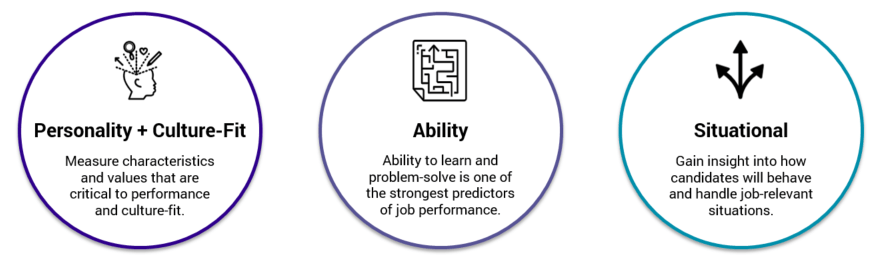
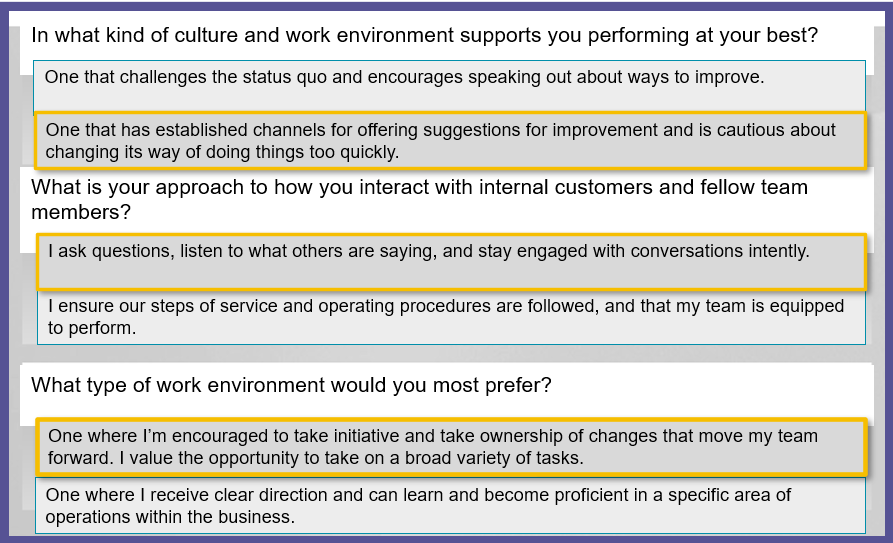
Those dimensions come to life in the candidate experience. Situational items reference your actual operations, and our assessment results can be customized with performance-based narratives that speak your language — helping to secure buy-in while ensuring you're hiring to meaningful and consistent standards.
3. Is the candidate experience engaging? What about the assessment completion rate?
The assessment is often a candidate's deepest interaction with an organization. Deeper than the job posting. Deeper than the application. For twenty or thirty minutes, they are being asked to demonstrate who they are and given an opportunity to perform.
How an organization treats a person during that window signals something. A thoughtful, well-designed experience says: we take this seriously, and we take you seriously. A clunky one says the opposite. And that signal doesn't expire on the start date. The person who eventually gets hired carries that first impression into how she approaches the work – and the people she serves.
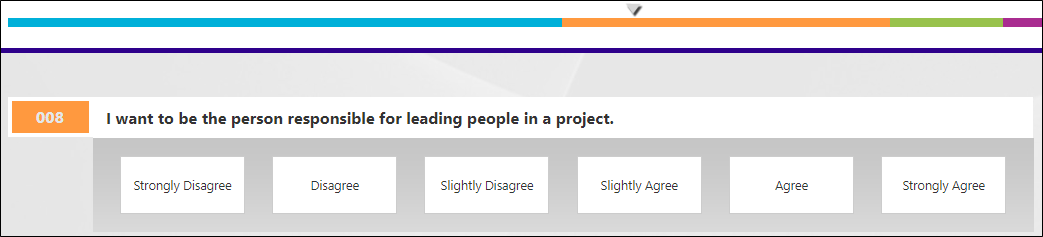
Ask about completion rates. Below 80 percent is worth investigating. Ask whether the provider has data on how candidates perceive the experience – not just whether they finish, but whether they felt it was fair. Ask about assessment length. An assessment that's too long frustrates candidates. One that's too short doesn't give them enough room to demonstrate who they are, and they notice.
Our completion rates can exceed 90 percent. Our assessments use varied question types – personality, situational, cognitive – at lengths calibrated to the role. Candidates see a progress bar throughout. They leave believing they were evaluated fairly and received the opportunity to perform. At Krispy Kreme, that approach handled 80,000 annual applications while maintaining completion rates above 90%.
4. Is the candidate experience mobile responsive?
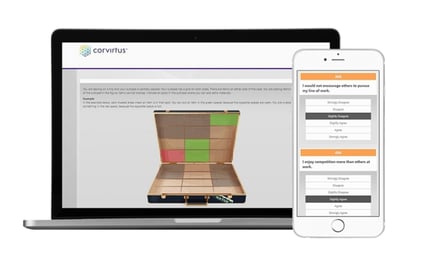
While we're on the topic of candidate experience, all of our assessments are mobile responsive and optimized. We know that more than 50% of candidates, especially those applying for entry-level positions, begin the process on a mobile device. Candidates can complete the entire assessment on a mobile device, tablet, or computer. They can also start on one device and finish on another with the link they've received. And, because our assessments are mobile responsive, the content (i.e., questions and response options) will automatically adjust to fit the size of the screen that the candidate is using, resulting in a candidate-friendly interface.
5. Are hiring assessment reports tailored to the needs of our recruiters and hiring managers?
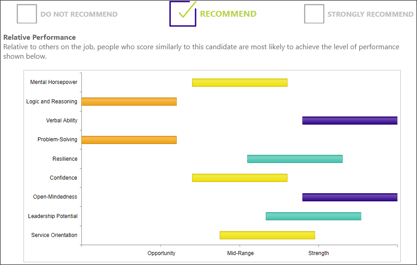
Our reports are built for operators, recruiters, and managers. Unlike many assessments on the market, there is no extensive training or certification required to understand our assessment results. Our results are designed with the hiring manager in mind – providing all of the information needed, when it's needed. The report opens with an overall recommendation for the candidate, along with how the candidate performed on the different competencies measured by the assessment. Additionally, each competency includes information describing the candidate's expected behavior and potential to perform, if hired. The information in the assessment result is designed to streamline and inform the decision making process by providing that overall recommendation and competency-based strengths and opportunities. Beyond hiring, the assessment result provides guidance on how to support the candidate's success if they are hired. Our assessment results are web-based and scored immediately after a candidate submits their assessment. Results can easily be printed out or shared with others electronically.
Check out this quick video on our assessment results.
6. Are your hiring assessments legally defensible?

Ask about track record. Ask about adverse impact monitoring, and alignment with the Uniform Guidelines on Employee Selection Procedures. Ask whether the provider collects voluntary demographic data to monitor for disparate impact – proactively, not reactively.
In five decades, our assessments have never been called into legal question. That's not an accident. It's the result of building every assessment with compliance embedded from the first item – not bolted on after the fact. Our assessments meet EEOC guidelines and provide an inclusive opportunity for neurodiverse candidates. We can collect voluntary protected-class information – separate from the assessment – so we can monitor continuously. Not because we're required to. Because it's how a system should be built.
Combined, these features, and our intense validation, support legal defensibility and create an experience that candidates view as engaging, fair, and something that enhanced their ability to perform. This is supported by our high completion rates.
7. Do you partner with us to document return-on-investment?
Turnover is expensive. That's not new information. What's less obvious is what turnover actually costs the customer. Every departure puts a less-experienced person in front of the guest, the patient, the client. Institutional knowledge walks out. The replacement is learning on the job while the customer absorbs the gap. The real return on a validated assessment isn't just the money saved on rehiring. It's the consistency of the experience your customers receive, month after month, because the people delivering it were selected for the right reasons.
Ask whether the provider measures ROI against your KPIs or just their own benchmarks. Ask whether they'll link assessment results to tenure, customer satisfaction, and performance outcomes specific to your organization – not industry averages.
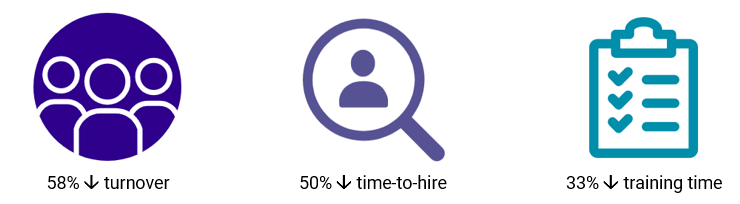
After just one year of implementation, Corvirtus assessments have helped companies achieve:
- 58% lower turnover
- 50% faster time-to-hire
- 33% less training time
We link assessment performance to your data. Turnover, satisfaction, controllable income, performance measures that matter to your culture. We actively seek this work because it lets us show – in dollars and in outcomes – what the return on investment looks like. One client found that employees who failed the assessment but were hired anyway were twice as likely to be terminated. At PDQ, managers who passed our assessments were ten times better at problem-solving and five times more likely to build high-performing teams. Those numbers came from the partnership – from tracking what happened after the hire, not just during it.
8. Will we have dedicated members of your team to provide support?
When something breaks at 5pm on a Friday – a candidate locked out, a manager who can't pull a report, a new location that needs to go live – the downstream consequences are immediate. A candidate walks away. A manager makes a gut-feel hire. A customer gets served by someone who shouldn't have been in the role.
Ask whether you'll have a dedicated contact or a ticket queue. Ask whether you'll have access to practitioners and psychologists, not just account managers. Ask what happens when a candidate – not just the buyer – needs help.
Ticket systems are not our thing. Every client has a dedicated person they can reach at any time, plus access to I-O psychologists and practitioners. Phone or email. Addressed immediately. We extend that to your employees and candidates, not just to you – because the person who needs help at 7 AM on a Monday is often the person standing between your customer and a bad experience.
The talent acquisition leader who started with three identical-sounding pitches now has a framework for telling them apart. Eight questions. Eight places where the answer reveals whether a provider understands what's actually at stake.
Because the person this decision affects most will never see an assessment score, read an ROI report, or sit in a vendor demo. She'll walk in the door, interact with the person who got hired, and form an opinion about the organization in about ninety seconds. The assessment that selected that employee is either working for her – or it isn't.
Already chosen a partner? The next question is what the first 90 days should look like — and where to watch for signs the partnership is working.
Next: Hiring Assessments: What to Expect in Your First 90 Days →
Frequently Asked Questions
What should I ask in an assessment vendor demo?
Ask for proof, not features. The strongest signals are validation tied to your specific roles, candidate completion rates backed by real data, a legal-defensibility track record, an ROI methodology connected to your KPIs, and who answers the phone when something breaks. Corvirtus built these eight questions to surface exactly that — operational understanding, not just product capability.
What is criterion-related validity in hiring assessments?
Criterion-related validity means an assessment has been statistically shown to predict specific job outcomes — tenure, performance ratings, safety records — using data from real applicants in the actual roles where it's used, not borrowed benchmarks from unrelated populations. Corvirtus runs these validation studies inside each client's own roles and industry, so the assessment predicts in your environment rather than in general.
How are hiring assessment benchmarks customized to a specific company?
Custom benchmarks are built by comparing candidates' assessment scores against a company's own workforce outcomes — retention, job performance, customer satisfaction — so scoring reflects the roles, industry, and environment where the assessment is used. Corvirtus sets these benchmarks from each client's performance data, which is what separates an assessment tuned to your operation from a generic tool applied broadly.
What completion rate should I expect from a pre-employment assessment?
Aim for a completion rate above 80%; anything lower means candidates are abandoning the process and your talent pool is shrinking before results come in. Mobile-first assessments that take under twenty minutes commonly reach 90–95% — the range Corvirtus assessments run, including at Krispy Kreme's 80,000 annual applications.
How do I know if a hiring assessment is legally defensible?
A legally defensible assessment is built to the EEOC Uniform Guidelines and SIOP's Principles for the Validation and Use of Personnel Selection Procedures, tested for adverse impact, and designed for ADA accessibility, with documentation demonstrating job-relatedness and fairness. Corvirtus builds compliance into every assessment from the first item — and in five decades, its assessments have never been called into legal question.
What is the difference between a validated assessment and a personality test?
A validated assessment predicts job performance in a specific role, backed by criterion-related validity studies that tie scores to real outcomes; a personality test measures traits without necessarily linking them to job success. Corvirtus builds assessments grounded in industrial-organizational psychology, so every item measures something that matters for performance — not just a personality profile.
assessments consistently achieve 90–95% completion rates because they're mobile-first, candidate-friendly, and designed to be completed in under twenty minutes without sacrificing predictive accuracy. At Krispy Kreme, that approach handles 80,000 annual applications.
How do I know if a hiring assessment is legally defensible?
We build to EEOC Uniform Guidelines and SIOP Principles for the Validation and Use of Personnel Selection Procedures. Every assessment is tested for adverse impact and designed for ADA compliance. We provide documentation demonstrating job-relatedness and fairness — the paper trail your legal team needs if a hiring decision is ever challenged. Five decades, never called into question.
What is the difference between a validated assessment and a personality test?
A validated assessment predicts job performance in a specific role, backed by criterion-related validity studies tying scores to real outcomes. A personality test measures traits without necessarily linking them to job success. We build assessments grounded in industrial-organizational psychology — every item measures something that matters for performance in your environment, not just a personality profile.