
Leadership in Skills-Based Organizations: Why the Best Performers Still Fail
TL;DR: The best contributor got promoted. Everyone agreed it was earned. Three months later, the organization lost the contributor, gained a struggling manager, and is missing key results. But the problem wasn't the person–it was the criteria. Organizations promote based on what someone has accomplished, not what the next role requires. The good news: leadership capabilities like relationship building, conflict resolution, and coaching are observable and assessable. When you add that information to how you promote and develop , the decision gets better–without reorganizing anything.
Cover Photo by Brett Jordan on Unsplash
The promotion went exactly as planned. The best performer said yes. The team was excited. The transition was smooth. Everyone agreed it was the obvious choice.
Three months later, the new manager is still swimming in her old routine: running the training sessions she was directed to delegate. She's still building the monthly reports. Clients still ask for her by name–and the team is eager to let her take over because it is faster and the quality is better when she does it.
She is not absent from the leadership role. She's just too present in the old one. She never stopped being the top individual contributor. She just added “manager” on top and kept executing.
The two strongest people on her team have stopped volunteering for projects. They are not complaining. They are not disengaged in any too obvious way. They have just gone quiet. Anyone who has led people long enough knows what quiet means.
Three layers of damage from one decision that everyone agreed was right.
The Promotion That Created Three Problems
The pattern is familiar because it is structural, not anecdotal.
Problem One: The organization lost the star contributor. The person who was exceptional in her previous role is now spending her time on tasks not considered in the promotion decision. Her development journey missed the core foundations of leadership. Her deep expertise, the thing that made her irreplaceable, is now buried under one-on-ones, priority shifting, and performance conversations she was never prepared to navigate.

Problem Two: The organization gained a struggling manager. We default to what we know–she does the work herself instead of coaching and developing others. She's not unwilling to delegate, but delegation remains a new and unpracticed skill. Facing overwhelm, the layup required to train and coach the team to replace her contributions is too much. Her quality standards are high. Letting someone else produce work feels irresponsible. So she takes on both jobs. She builds the monthly reports and manages the team and puts out fires. She runs the client sessions and approves the schedules. But now she's become the bottleneck she was promoted to eliminate.
Problem Three: The organization is losing current and future performance. The people working with her came in expecting development, coaching, and growth. Instead, they are watching their manager do their work for them (not the worst thing from their perspective). But the message they are receiving, whether she intends it or not, is that she does not trust them to do it right. The two strongest performers have gone quiet.
From Anecdote to Reality: The Skills-Based Gap in Leadership Transitions
If you’ve worked in people management or HR, this probably feels familiar. It shows up at the heart of many of the challenges organizations share with us when they reach out for support.
Consider that -
-
Roughly six in ten newly promoted managers struggle or fail within their first two years.
-
Managers account for seventy percent of the variance in employee engagement.
-
One in two employees (half of the workforce!) has left a job specifically because of their manager at some point in their career.
To be direct, this is not a story about one bad promotion–it is the workplace equivalent of evening reruns on cable television. It plays across industries, departments, and years, with different names and the same plot. The star contributor gets the title. Everyone agrees it is deserved. Then people and results start to slip. The organization pays for it three times: first by losing a high-performing individual contributor, then by funding the burnout of a now-struggling manager, and finally when the team quietly heads for the exit.
The pattern has takes three forms, and most organizations have seen all of them:
-
The trainer who cannot delegate. Deep expertise, high standards, trusted by clients. She gets promoted and keeps doing the work herself because nobody else does it to her standard. The team atrophies. What was a thriving group of developing professionals becomes a support staff for one person doing two jobs.
-
The senior individual contributor who cannot navigate conflict. Brilliant at her craft, respected for technical judgment. She's promoted into a role where people disagree with each other, and she has to manage the tension (without experience). She either avoids the conflict—and it festers—or handles it like a technical problem with a correct answer and watches it escalate. Neither builds engagement or cohesion. Neither teaches and coaches. The team learns not to surface disagreements, which means the problems go underground.
-
The high performer who cannot develop others (likely because they weren't trained). Her strength was execution. She could outwork anyone. But leadership is not about outworking—it is about multiplying capability. She cannot teach what she does instinctively, and she cannot slow down long enough to let someone else learn by doing. Her team stops growing because she cannot stop producing.
Each pattern shows a different face of the same gap: the skills that earned the promotion are not the skills the role requires.
Wonder which leadership capabilities you already have–and which ones the role will demand? Take our quick assessment and see what patterns show up.
It Is Not a People Problem–It Is a Skills-Based Hiring and Promotion Problem
When a promotion fails, the most common conclusion is that the organization picked the wrong person. It is a reassuring story because it implies the system works—you simply need to choose better next time. Yet even when the data tells a different story, it is easy to become skilled at crafting narratives about what went wrong.
The problem is not the people being promoted. The problem is the criteria. Organizations promote based on performance in the current role. The best salesperson becomes the sales manager (hello, Michael Scott). The best trainer becomes the training director. The best engineer becomes the engineering lead. The choice is made on what someone has already done, not on what the next role actually needs—like casting based on last season’s script instead of this year’s job description.
The promotion did not fail because they chose the wrong person. It failed because they used the wrong criteria.
Most organizations promote their way into leadership problems. Not because they choose the wrong people–because they select people for the wrong reasons.
The evidence is striking.
-
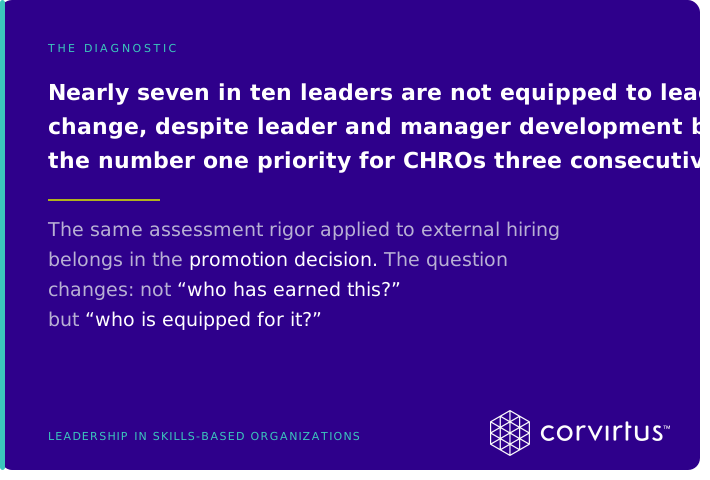
Nearly seven in ten leaders are not equipped to lead change, despite leader and manager development being the number one priority for CHROs three consecutive years.
-
Three-quarters of HR leaders report that their managers are overwhelmed by the expansion of their responsibilities. Organizations are spending more on leadership development, updating their programs, and still not seeing results.
-
And conditions are unlikely to improve. Only forty-nine percent of key positions could be filled internally today. If we look only at HR as an example just twenty percent of HR leaders have successors ready for critical roles.
The budget isn't the problem. It is the wrong selection criteria feeding the wrong development approach, producing the same result. Homegrown development programs built on intuition rather than measurement. Flavor-of-the-month interventions that feel productive but do not transfer to behavior. Training workshops where leaders learn what to do and then go back to doing what they have always done.
And the downstream cost of a single failed promotion? Direct replacement costs up to two hundred percent of salary for leadership roles, before accounting for team attrition, lost institutional knowledge, productivity, and the engagement collapse that follows a struggling manager.
Here is what makes this a skills-based organization problem rather than a management training problem: the rigor most organizations apply to external hiring disappears when someone is promoted internally. The same leadership and HR team that would never hire an outside candidate for a leadership role without a structured interview process and clear criteria will often promote an internal contributor based on tenure, performance reviews, and consensus. In other words, the careful assessment you apply to external hires tends to fade right when it is needed most.
A skills-based organization treats promotion as a critical strategic decision, not a recognition tool. But more than a third of organizations use promotions as a retention and recognition tool. When internal hiring becomes strategic and evidence-based it asks whether the person has the capabilities the role requires—not whether they have earned the title.
Same Talent. Different System. Different Outcome.
Two organizations. Same performer. Different approaches to the promotion decision.
Organization A promotes and hopes (prays). The best regional trainer is the obvious candidate. Strong relationships across the board, deep subject matter expertise, the person everyone goes to. She gets the title. No one assesses whether she can delegate, develop others (outside of structured training), or navigate the political dynamics of managing former peers. Within three months, she is doing two jobs. The training team falls behind on new roll-outs. Six months later, leadership is managing the fallout—potential burnout for the manager, disengagement from the team, and exit interviews—that all point to the same root cause.
Organization B assesses and develops before they promote. Same talent. Same performance record. But before the promotion decision, the organization shares an assessment that maps the gap between what makes her excellent as a trainer and what the leadership role requires. It reveals she is strong on expertise, building relationships, and quality standards, but is likely to struggle with delegation, systems thinking, conflict resolution, and building her own team.
For Organization B these gaps are not a concern. She's not disqualified. It informs the decision and her journey. Now the COO and CHRO hold options they did not have before.
-
They can develop the candidate in the specific areas the assessment identified before, and after, promoting her—delivering targeted, experiential work on delegation and team development, not a generic leadership workshop.
-
They can strategically expand her scope before promotion in ways that support her future role.
-
Or they can promote a different candidate whose capability profile already fits what the role demands.
No path is right or wrong. The point is that without the assessment, they only had two choices: promote and hope/pray, or risk losing their best person. That binary exists because we lacked data.
This is not an expensive infrastructure-heavy project. The organization did not reorganize, build a parallel career ladder, or create new job titles. It added one step–just assess the internal candidate–and the decision got better. A 300-person company does this the same way a 10,000-person company does. The meeting is the same. The decision-makers are the same. The difference is what information is in the room.
As you might expect, sometimes the assessment reveals a gap that is developable—a candidate who has the foundation for leadership but needs targeted development in specific areas before stepping into the role. That is a different decision with a different timeline, and it is worth its own treatment. What matters here is the diagnostic: the same criteria were being used for two fundamentally different jobs, and the person’s highest value was somewhere the promotion would have buried.
Same talent. Better information. Different outcome.
Why Skills-Based Competencies Matter in Hiring + Promotion

The skills leadership demands are not the same ones that made someone a standout individual contributor. It sounds obvious when you say it out loud—and yet, in practice, many organizations behave as if a promotion comes with a magical upgrade button like we're buying airline tickets.
-
Delegation is not handing off tasks. It is letting go of the work you do best–the work that earned your reputation, the work clients ask for by name–and trusting someone else to do it differently, possibly worse at first, because that is how capability gets built. A contributor’s instinct is to take it back. A leader’s discipline is to stay out of it.
-
Conflict resolution is not avoiding disagreement or resolving it quickly. It is managing the tension between people who see the same situation differently and need to keep working together afterward. An individual contributor can sidestep most interpersonal friction by outperforming it. A leader cannot. The conflicts come to her, and the team watches how she handles them. This is where influence becomes a leadership capability, not just a collaboration skill.
-
The skills of team development, like teaching and coaching, is not mentoring. It is systematically building capability in others–identifying what each person needs to grow, creating conditions for that growth, and measuring whether it is happening. A contributor multiplies value by producing more. A leader multiplies value by making other people better at producing.
-
Strategic systems thinking is the shift from “how do I do this?” to “how does this team do this?” It requires seeing the work from above the execution layer–understanding dependencies, allocating effort, and making tradeoffs that optimize for the team’s output rather than any individual’s workload.
These are not personality traits. They are observable, measurable skills. The distinction matters–traits suggest you either have them or you do not. Skills suggest you can build them if you know what to build. A leadership competency model defines the target. Without one, promotion decisions are guesswork dressed up as meritocracy. Organizations that build competency models around performance and inclusivity can name these capabilities before they need them.
Performance reviews and feedback can capture some of this information—if we're looking at what's required in the future, not just now. To what extent had our hypothetical training manager demonstrated systems thinking when there was an opportunity?
But the gap between what we can measure from current performance, and what's required in the future is still there. And that's where validated assessments can support our success.
Explore a situational assessment that could highlight strengths, vulnerabilities, and how to close gaps before they derail potential.
That gap between what gets measured and what the role requires is where the problems start.
Building a Leadership Competency Framework Before the Title
When leadership can be clearly seen, it can be clearly measured. And when it can be measured, organizations can select and develop for it before granting the title—rather than trying to repair the damage afterward.
This requires three (proactive, but realistic) shifts in the process.
-
Assess before promoting. Map the gap between what makes someone great at their current role and what the leadership role actually requires. Measure the competencies core to the role. These will likely include core competencies like delegation, conflict resolution, teaching and coaching (long-term), and strategic systems-wide thinking. Consider how accurately you can benchmark demonstrated ability in the current role and how validated assessments of future potential can maximize information. Succession planning grounded in assessment data looks fundamentally different from succession planning grounded in tenure and manager intuition. It identifies readiness rather than availability.
-
Develop before the role. Build targeted development pathways that close the specific gap the assessment identified. We're not talking about generic leadership workshops. This isn't one-time conference attendance. Nor is it a reading list. There is a reason leadership training often fails to stick–it teaches concepts without building capability. The alternative is specific, experiential skill-building in the areas where the gap exists. Roughly seventy percent of leadership development comes from on-the-job experience, twenty percent from developmental relationships, and only ten percent from formal training. The development approach that works enables on-the job application as well as time for reflection and learning. Employee development tailored base on insights from assessments successfully transfers to learning and behavior. Development that is built from a course catalog does not.
-
Make the promotion decision with the right data. Most organizations face a false choice: promote top contributors into management or risk losing them. That binary exists because we can't see all the opportunities available. Assessments remove this mindset. When the CHRO and COO can see that their best regional trainer is strong on expertise and but completely new to delegation, they are no longer choosing between “promote” and “lose.” There are useful third, fourth, and fifth options. We can see how we can enable a growth journey that supports individual growth and the business.
Let's return to the beginning of our story. What would it look like if the organization assessed performance and potential first? Assessments happened before the title change. Gaps were visible. Clearly, change and promotion come with bumps, but the all-too-common fallout was averted. The new head of training and development receives growth, recognition, and expanded scope in her zone of excellence. The leadership role enabled her journey and success because the experience was attuned to her capabilities. Team commitment and retention stays high because we began with a skills-based approach.
Ready to see the gap before the title? See how this situational assessment could highlight strengths and vulnerabilities in your high potentials.

About Corvirtus
Corvirtus has spent five decades years building assessment and development systems grounded in the science of industrial-organizational psychology. We measure the capabilities that predict leadership effectiveness with a skills-based and culture-focused approach that supports both intended business success and personal and professional growth.
We support organizations across hospitality, healthcare, aviation, and beyond to build systems that assess leadership readiness before the title, develop capabilities before the role, and create growth journeys that give everyone an opportunity to flourish. How we support our clients
- Succession Planning–identifying leadership readiness through assessment, not assumption
- Employee Development–building leadership capabilities before the promotion
- Hiring Assessments–applying assessment discipline for hiring
- Competency Models–defining what leadership actually requires in the role
FAQ
Why do high performers struggle and fall short of intended results when promoted to leadership roles? High performers fall short in leadership because the skills that made them exceptional contributors—technical skill, execution speed, attention to detail—are not the skills leadership requires. For many, the skills of leadership are new ground. Success demands skill in delegation, ongoing teaching and coaching, conflict resolution, and strategic systems-wide thinking. When we promote based on current performance without assessing leadership readiness, the new manager defaults to doing the work, the team stops growing, and we productivity (and culture) setbacks.
What is a leadership competency model and how is it used in promotions? A leadership competency model defines the specific, observable capabilities a leadership role requires. It defines the distinct skills required and how required skills change as roles progress. In promotion decisions, it serves as a measurement tool: mapping the gap between a candidate’s current capabilities and the role’s requirements. This clarity is important so we can assess readiness before the title instead of discovering the gap afterward.
Can you assess leadership potential before someone is promoted? Yes. Leadership capabilities like delegation, conflict resolution, teaching and coaching, and systems-wide strategic thinking are observable and measurable. Assessment before promotion maps the gap between what makes someone strong in their current role and how the new potential role will differ. This allows organizations to develop specific capabilities before the transition. At a larger scale, future leaders are simultaneously developed on core competencies. It can also assist with career trajectories; determining if someone evolves into an expert-level individual contributor or explores leadership.
What is the difference between leadership training and leadership development? Leadership training is one component of leadership development. It typically delivers knowledge in structured settings like workshops, conferences, courses. Leadership development is an experience that builds capability through targeted, experiential practice in the specific skills a role requires in combination with training. Research shows roughly seventy percent of leadership learning comes from on-the-job experience rather than formal programs. The distinction matters because most leadership development budgets fund training activities rather than development systems that support a full journey for growth.
How do skills-based organizations build their leadership pipeline? Skills-based organizations treat leadership as a measurable skill set, not a reward for past performance. They assess leadership competencies before promoting, build targeted development for identified gaps, and create dual advancement tracks–leadership and expert–so top contributors can grow without being forced into management. The pipeline selects on capability fit, not tenure or performance history.
What should a leadership development plan template include? A leadership development plan should map specific capability gaps identified through assessment, not generic leadership topics. It includes the target competencies for the role, current proficiency levels, experiential development activities rather than classroom training, measurable milestones, feedback mechanisms, and a timeline. The strongest plans are role-specific and built from assessment data rather than one-size-fits-all frameworks. For a glimpse into the strategies we incorporate into our growth journeys for individual contributors and leaders, access our sample Growth Map below.