
TL;DR: We open with the “measurement layer” behind hiring assessments—arguing that most organizations rely on vague labels (“strong communicator,” “team player”) when assessing talent and what is actually required are tiered behavioral frameworks. We walk through two concrete examples: communication broken into Learning → Achieving → Leading tiers, and problem solving shown at individual contributor vs. senior leader scope. The key move is showing how those tiered indicators double as development pathways—the gap between your current tier and the next one is the development plan. It closes by previewing how individual competencies compose into a full framework
Most (upwards of 90 percent) organizations have a system for assessing talent. Performance reviews, pre-hire assessments, promotion checklists, manager recommendation forms—the infrastructure exists, and it captures something. But look at the language inside those forms and a pattern emerges. Strong communicator. Team player. "Ready for the next level." When every candidate for a leadership role sounds the same on paper, the system is capturing opinions, not observations.
Skills-based leadership in hiring and promotion depends on assessing what candidates and employees actually do at each level of capability—not what managers feel about them generally. The gap between those two things is where hiring and promotion assessments either deliver real insight or just add another label to the stack.
We're going to start with talking about measurement—what hiring assessments built on behavioral indicators contain, and why the difference between a label and a framework changes how organizations make talent decisions.
What should talent assessment accomplish?
The internal processes most organizations rely on—performance reviews, promotion checklists, manager recommendation forms—were built to document past performance. They do that reasonably well. The forms exist for a purpose, and they serve it. The gap is not in the system itself. It is in the distance between what the system was designed to do and what talent decisions actually require.
A hiring or promotion decision asks a fundamentally different question than a performance review. The review asks: how has this person performed in the current role? The talent decision asks: does this person have the capability to perform in this new role? Most hiring assessment tools and internal review processes were not built to answer the second question. And this is where the length of an assessment matters less than whether it measures the right things.

These are the mandatory objectives a talent assessment system needs to provide when it is supporting a decision:
-
Show what a skill looks like at different levels of mastery. Not “strong communicator” (strong at what?). Communication looks wildly different at the frontline, mid-level management, and senior levels. Each needs a precise definition before we can consistently measure it.
-
Tell a leader (or any key stakeholder, like learning and development teams) what specific behaviors to observe and develop. We need precision: a description of what the person actually does during key and critical moments on the floor, in a meeting, or during a crisis.
-
Create a pathway from current capability to next-level readiness. Not a rating (although that might be one piece)—a map that shows where someone is and what building toward the next tier looks like in practice.
The way most assessments are applied they stop at labels. Personality categories (High dominance! Collaborative! Steady!), trait scores, fit percentages, “ready for next level.” These are useful starting points. They tell an organization something about its people. But labels alone cannot do any of the three things above. At what level is the incumbent or candidate likely to perform? Implicit bias compounds the problem—when measurement is vague, subjective impressions fill the space.
That gap is what makes talent decisions harder than they need to be. Most talent assessment systems were not built to inform the decisions they are directing.
Leaders that recognize this gap often discover that the issue is not a lack of data—it is a lack of the right kind of data. When the time comes to evaluating hiring assessment providers, eight essential questions can separate a real measurement partner from a slide deck. But first, the next question is what that data actually looks like.
What Talent Measurement Actually Looks Like—Skills-Based Hiring in Practice
Skills-based hiring requires knowledge of the skill at each level of capability. That is what competency-based talent management provides—not a score, but a behavioral description at each tier.
Consider communication. Not the word on a performance review—the actual competency, broken down into observable behaviors at three levels of mastery.
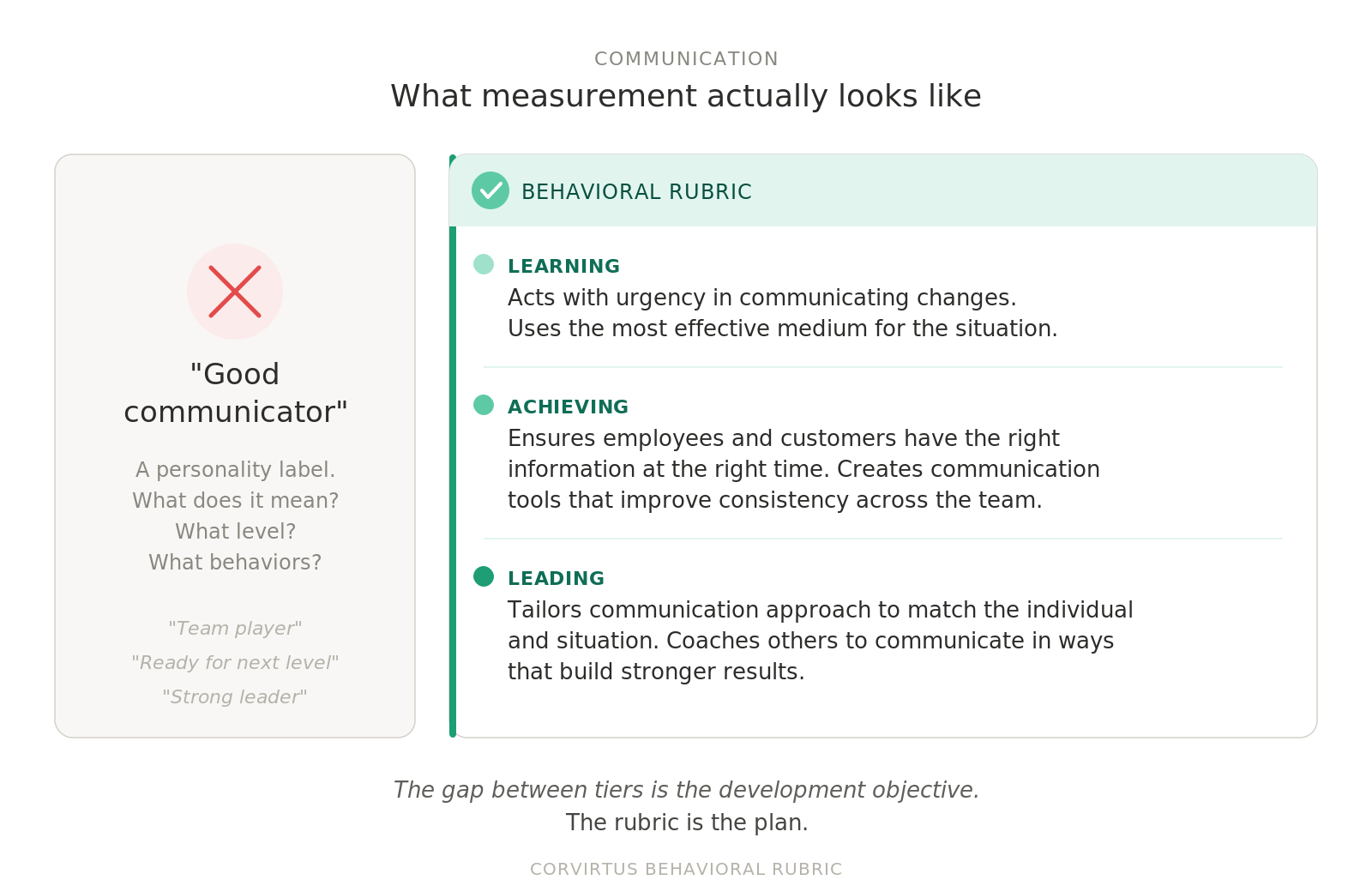 “Good communicator” is a label. It might appear on a performance review or in a manager recommendation form. But what does it mean? It tells a decision-maker something—but not enough. The framework delivers a rubric with three tiers. The behaviors are observable and coachable. We can strategically target these behaviors at the person, team, or organizational level.
A hiring assessment built on this structure measures something actionable—not whether someone is a good communicator, but what their communication actually looks like at each level of capability. We can calibrate assessment to the level of communication required of the role. This framework and rubric gives us the start of what we need for sound structured interviewing.
The pattern holds across competencies—influence, coaching, leadership, each one breaks down the same way. But the second dimension is what matters most for promotion decisions: how the same competency evolves as the role gets bigger.
Let's take problem solving. At the individual contributor level, the behavioral indicators describe someone who applies knowledge and understanding for concrete job tasks. The measurement is about personal execution—can this person solve the problems in front of them?
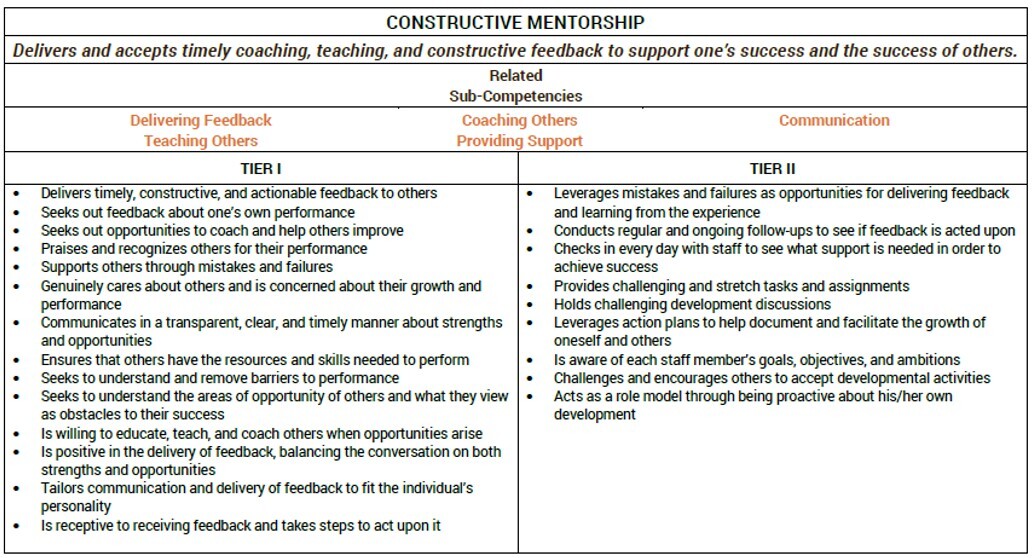
At the senior leadership level, the same competency looks fundamentally different. We're assessing for their ability to handle future demands we cannot as easily predict. The behavioral indicators describe someone who thinks about systems, develops strategy aligned with vision, and empowers others to solve problems independently. The measurement is no longer about personal execution. It is about enabling capability across the organization.
This is the dimension that connects directly to the talent decision. The question we're trying to answer with promotion is not just “how good is this person at problem solving?”—it is “does their problem solving look like what the next role requires?” The behavioral indicators at each level answer that question in observable, specific terms.
Together, these two examples show both dimensions of the measurement layer. Communication shows the vertical—how a single competency progresses within a role, from Learning through Achieving to Leading. Problem solving shows the horizontal—how the same competency transforms as the scope and responsibility of the role change. Measurement isn't a black box—the science behind it is observable and explainable.
Lots of hiring assessment vendor says “we measure soft skills.” The question worth asking is: measure them how—and what are they? The answer separates a simple label from information that will drive performance and growth.
Assessment Creating Pathways for Growth
Competency by competency, measurement defines how performance evolves across levels of complexity. We can track tiers of mastery (e.g., learning, achieving, leading) and what that looks like at different levels across the organization (e.g., frontline, support center individual contributors, leaders, senior leadership).

The gap between where someone's level of competence and the next level drives development. We can also explore what moving into a different category (like going from frontline to support center) might look like in terms of future performance.
When an organization can see that a frontline leader is at the Learning level of communication, the next tier—Achieving—is more likely to become shared understanding, not a vague aspiration. The behavioral indicators at the Achieving tier are the development objective.
This is where employee and leadership training and development shifts from generic programming to targeted capability building. 'Develop competence in communication' is a goal without a system.
Moving from ‘uses the most effective medium for the situation’ to ‘creates communication tools that improve consistency across the team' is a clear objective that can support the individual, their manager, and scale across the organization. The behavioral indicators at the next tier guide focus.
The same structure works for any competency. Problem solving at the individual contributor level has a defined path to senior leadership—and the behavioral indicators at each level describe exactly what the progression looks like. A leadership development program built on this structure does not just tell someone they need growth. It tells them exactly what growth looks like for their competency at their level.
This is what makes proactive development possible. We can support new hires with targeted development to close gaps. Instead of estimating we can know that strong performers and our future leaders receive the training and development they need to be successful in their next role. These are the principles driving skills-based leadership in hiring and promotion.
Clearly defined behaviors put us not just on the same page, but the same sentence and line. Without that definition, development is a road trip without a map. With it, development has a destination and shared route.
How to build a competency-driven talent assessment program

Individual competencies do not exist in isolation (at least not successfully). In a skills-based organization, they exist in a framework that includes all roles and define the flow across positions and levels.
We often break competencies into four categories that make it easy to reference how they impact performance.
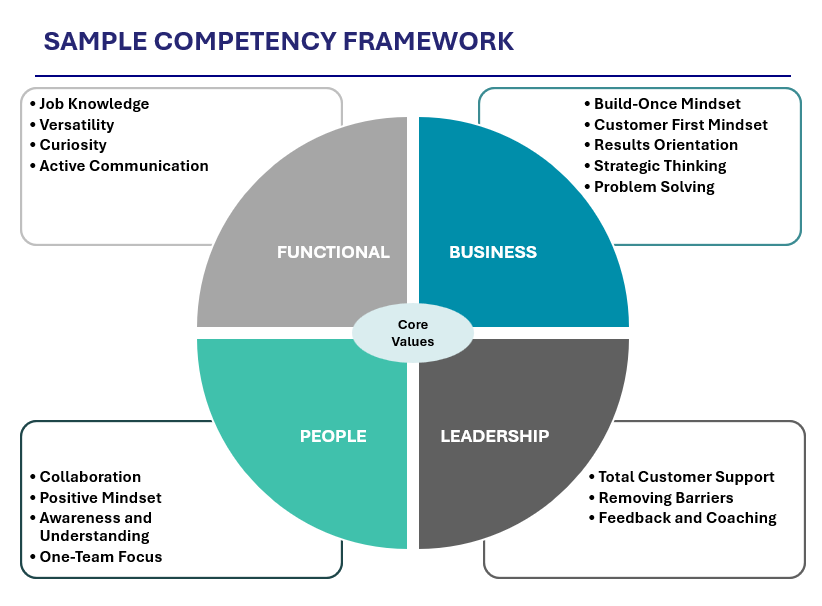
1. Self. The competencies that influence our behavior and results in any situation. Our energy, way of organizing information, approach to consistently showing up.
2. People. Competencies that drive collaboration, relationship building, and working effectively with others.
3. Business and Results. What clusters of skills and abilities as well as values and mindsets influence how we work within the business? How an individual contributor or leader achieves key results? This might include problem-solving, flexibility, and creativity.
Competencies shift as roles change—and the behavioral indicators shift with them. Compassion for frontline individual contributors (falling under People) may focus a lot on how they take care of customers and end stakeholders. However, for corporate support individual contributors that may change to cultivating empathy and understanding the perspectives of internal customers across the organization.
This is the architecture that drives successful measurement. Competencies (communication, problem-solving, coaching) come with tiered indicators. Each is a building block. Together they build a system that defines what a role requires at each level of the organization. They give us concrete data for building structured interviews and assessment programs.They make consistent talent management possible. In our next conversations we'll show what a full leadership competency framework looks like when it is built on this structure and how to use it to maximize consistency and performance across your organization.
Frequently Asked Questions
What do hiring assessments actually measure?
Hiring assessments should measure behavioral indicators at defined competency tiers—not labels that sound useful but tell you little about future performance. The gap between “strong communicator” and a real hiring assessment is the gap between opinion and evidence. A validated assessment shows what communication, problem solving, coaching, or judgment actually looks like in observable, specific terms at the level the role requires. That is what makes the measurement actionable. It gives hiring leaders clearer criteria for selection, stronger foundations for structured interviews, and a development pathway that starts the moment a candidate becomes an employee.
How do you measure soft skills in the hiring process?
A hiring process measures soft skills by defining them in observable, specific terms and assessing them at the level the role actually requires. Not “good communicator”—what communication looks like when someone is learning, achieving, or leading. Not “strong problem solver”—what problem solving looks like when the work is individual, cross-functional, or strategic. A validated hiring assessment turns soft skills into behavioral indicators a manager can recognize, compare, and discuss in structured interviews. That is what makes the measurement useful. It does not stop at a label. It shows what a competency actually looks like in practice and whether that pattern of behavior matches the demands of the role.
What is a competency-based assessment?
A competency-based assessment measures behavioral indicators organized by competency and tier—not broad labels or personality categories (like Dominant, Relator, or Strong Communicator). It shows what a person can actually do at the level the role requires, in observable, specific terms. That is the difference between knowing someone scored well and knowing whether their communication, coaching, judgment, or problem solving matches the demands of the role. Because the structure is built around defined competencies and progression tiers, it supports both the hiring decision and what comes next—targeted development tied to the next level of capability.
What is the difference between a personality test and a behavioral assessment?
A personality test categorizes tendencies and preferences—introvert or extrovert, analytical or relational. A behavioral assessment measures something different: what a person actually does at defined competency tiers, in observable, specific terms. That is the gap between a profile and a hiring decision. A profile may describe how someone is wired. A behavioral assessment shows whether their communication, judgment, coaching, or problem solving looks like what the role requires now—and what the next level of capability requires next. Both can provide useful information, but only one gives hiring leaders a development pathway built into the measurement.
How do competency tiers work and why should we have them?
Competency tiers work by defining what a competency looks like at each level of mastery—like our examples here, Learning, Achieving, and Leading—with observable behavioral indicators at every tier. That structure matters because it replaces vague labels with evidence a manager can actually use. Instead of saying someone is “ready” or “not ready,” we can see what communication, coaching, judgment, or problem solving looks like now, what the role requires next, and where the gap sits between the two. That makes it pretty clear why we should build them into our talent assessment systems. Tiers make hiring and promotion decisions more precise, align assessment to the actual demands of the role, and turn development into a clear pathway rather than a generic intention.
About Corvirtus
Corvirtus is a talent management firm built on the science of industrial-organizational psychology. We bring five decades of serving service-driven organizations in how they hire, develop, and retain exceptional people. In service-driven organizations, that means building teams where communication isn’t left to chance, but potential is assessed at hire, developed through targeted tools, and reinforced by a culture designed for it. Corvirtus works with manufacturers, healthcare organizations, restaurants, and organizations across the service sector to measure the competencies that predict team performance, reduce preventable turnover, and improve the customer and employee experience.
Learn more about how Corvirtus supports talent decisions and development at every level:
Take a Competency Focused Assessment
Curious what a competency framework and measurement could look like for your team? Take a quick assessment that measures performance of Self, People, and Business and Results competencies and see what patterns show up in your own profile.