Strategies for Improving Candidate Selection and Retention
Enhancing Recruitment Effectiveness through Realistic Job Previews

Enhancing Hiring with Realistic Job Previews
Realistic Job Previews (RJPs) are tools designed to give potential employees a clear and honest view of what a job entails before they commit to it. By providing a balanced perspective of both the positive and challenging aspects of a role, RJPs help candidates make informed decisions about whether the job aligns with their expectations and career goals. This approach not only aids in setting realistic expectations but also reduces turnover by ensuring that new hires are genuinely suited for the position.
Implementing RJPs can lead to numerous benefits for organizations. They help attract candidates who are better aligned with the company culture and job requirements, ultimately improving job satisfaction and performance. Additionally, by reducing the likelihood of early turnover, RJPs can save companies significant costs associated with recruitment and training. Overall, RJPs serve as a strategic tool to enhance the hiring process and foster a more committed and engaged workforce.
Featured image by Igor Omilaev For Unsplash+
Table of Contents
- Enhancing Hiring with Realistic Job Previews
- Key Benefits of Realistic Job Previews
- Reducing First Year Employee Turnover
- Authentic Candidate Experience
- Realistic Job Previews and Preventing Honeymoon Hangovers
- Little Realistic Job Previews Everywhere
- Spaceholder
- Spaceholder
- Spaceholder
- Spaceholder
- Takeaways
- Conclusion
Photo by Brooke Cagle on Unsplash
Realistic Job Previews (RJPs) offer several key benefits that enhance the hiring process. Realistic Job Previews (RJPs) are essential for aligning candidate expectations with actual job demands, enhancing job satisfaction and retention. RJPs provide comprehensive insights into job responsibilities, challenges, and organizational culture, allowing candidates to make informed decisions. By offering transparency, RJPs can reduce turnover, improve engagement, and build a trustworthy employer brand.
Companies like Southwest Airlines and Patagonia exemplify the effectiveness of RJPs in attracting candidates who resonate with organizational values, leading to a more committed workforce. Implementing RJPs involves assessing recruitment processes, training hiring managers, and continuously refining the approach based on feedback.
Reducing First Year Employee Turnover
Photo by Getty Images For Unsplash+
Realistic job previews (RJPs) are an effective tool for reducing turnover among first-year employees. By providing candidates with a clear and honest depiction of the job, including both its positive and challenging aspects, RJPs help set accurate expectations. This transparency allows potential employees to make more informed decisions about whether the role is a good fit for them, ultimately leading to higher job satisfaction and lower turnover rates.
Implementing RJPs involves several strategies, such as incorporating realistic scenarios in job descriptions, using videos or testimonials from current employees, and offering job shadowing opportunities. These methods give candidates a comprehensive understanding of the job and the company culture. As a result, organizations can improve their recruitment processes, enhance employee retention, and build a more committed and satisfied workforce.

Consider these benefits -
Reduced Turnover
RJPs help set accurate expectations for candidates, leading to higher job satisfaction and lower turnover rates among first-year employees.
Improved Candidate Selection
By providing a clear depiction of the job, RJPs enable candidates to make more informed decisions, ensuring a better fit for the role.
Enhanced Employee Retention
Candidates who have a realistic understanding of the job are more likely to stay longer, contributing to a more stable workforce.
Better Organizational Fit
RJPs help candidates understand the company culture and job demands, leading to a more committed and satisfied workforce.
Authentic Candidate Experience
Photo by Getty Images For Unsplash+
Building realistic job previews and embedding them into your hiring process is not just a strategic win, but a core step in building authenticity - and an employment brand and culture people believe in. By providing candidates with a comprehensive view of the role and your culture, you set them on a path to making informed decisions. In a world where nearly half of new hires regret their decision, you're taking steps to build trust and respect, ultimately contributing to a more committed workforce. Remember that the authenticity and depth of your candidate experience can only happen by knowing the authentic beliefs and experience of your new hires and candidates today.

Here are some questions to begin the process of building a realistic job preview:
-
- First, what job groups are involved? If culture is the main focus, one job preview may be enough. However, if your culture is coming to life in ways that are unique for each job, then we may need to consider unique job previews (e.g., frontline employees, support center team).
- Next, gain an understanding of critical incidents around retention and a positive new hire experience: what are examples and events of great success and failure early in the employee journey? Interviews, focus groups, and existing records provide useful information.
-
If competencies are defined for this job group, identify what contributes to success or failure in those areas. Record the essential role requirements that frequently present challenges early in the employment. Consult with recruiters and hiring managers to determine what they find frustrating about candidates' lack of understanding, or more critically, what new hires fail to grasp or are not ready to execute.
.png?width=641&height=481&name=Four%20Part%20Diagrams%20-%20blogs%20and%20things%20(1).png)
New hires frequently begin jobs with little understanding of the difficulties they are about to face, whether it’s juggling a heavy workload, or navigating the company culture. The fact that nearly half of us regret our decision in the first week supports this. A Realistic Job Preview (RJP) provides potential employees with a thorough understanding of the job, showcasing both its advantages and challenges.
It’s also normal for us to bring our best selves for the first couple months on a job, doing everything possible to build a bright reputation and perhaps suppressing their natural personality and working to the point of strain and burnout. After a few weeks or month on the job, satisfaction and engagement can plummet resulting in poor performance and turnover – the honeymoon hangover. Even if a disappointed employee stays beyond this period, beliefs and perceptions from the first weeks on the job linger to potentially derail results later. As stewards of our teams we have only the first five weeks to earn the trust and commitment of those that chose to join us.
Little Realistic Job Previews Everywhere
Discover why passionate employees can sometimes be taken for granted in the workplace—and why stepping back to recharge is essential. See how Realistic Job Previews engage candidates from the start and help prevent avoidable frustrations with new hires down the road.
Photo by Getty Images For Unsplash+

Cognitive Ability
- Problem-Solving: Ability to identify issues, generate solutions, and implement effective strategies.
- Logical Reasoning: Skill in analyzing situations, spotting patterns, and making decisions based on facts.
- Verbal Reasoning: Capacity to understand, analyze, and draw conclusions from written information.
- Numerical Reasoning: Proficiency in working with numbers, including basic arithmetic, data interpretation, and logical reasoning involving numerical information.
Personality
- Openness: Willingness to embrace new experiences and ideas.
- Conscientiousness: Level of organization, dependability, and work ethic.
- Extraversion: Degree of sociability, assertiveness, and enthusiasm.
- Emotional Stability: Ability to remain calm and composed under stress.
Skills
- Technical Proficiency: Ability to perform specific technical tasks related to the job.
- Job Knowledge: Understanding of job-specific information and procedures.
- Practical Skills: Competence in performing hands-on tasks and using tools or equipment.
- Problem-Solving Ability: Capability to address and resolve job-related challenges effectively.
Situational Judgement
- Problem-Solving: Ability to assess situations and determine effective solutions.
- Decision-Making: Skill in making choices in scenarios with multiple potential outcomes.
- Interpersonal Skills: Effectiveness in dealing with others, including teamwork and communication.
- Conflict Management: Capability to handle and resolve conflicts in a constructive manner.
What Questions Should You Ask a Potential Hiring Assessment Provider?
When selecting a hiring assessments provider, it’s important to ask key questions to ensure they meet your needs.
- Inquire about the validity and reliability of their assessments to ensure they accurately measure what they claim to.
- Understand the provider’s approach to compliance with legal standards and how they handle data privacy.
- Evaluate the customization options available to tailor assessments to your specific job roles and organizational culture.
- Finally, consider the support and training they offer to help you effectively implement and interpret the assessments.
These factors will help you ask helpful questions and select a provider that enhances your hiring process and supports your organizational goals.

Common Myths to Hiring Assessment Tools

Personality assessments are often misunderstood in the hiring process, with many believing they allow for discrimination based on age, race, or other protected classes. However, these tests are designed to avoid such biases by focusing solely on job-related characteristics. The Equal Employment Opportunity Commission (EEOC) mandates that these assessments be evaluated to ensure they do not disproportionately affect any group. By concentrating on traits relevant to job performance, personality tests provide an unbiased source of information, helping hiring managers make more informed decisions without considering irrelevant personal characteristics.
Another common assessment myth is that job-related experience is more valuable than personality testing. While experience is important, it doesn’t always predict success in a new role, especially in different organizational cultures. Personality assessments offer insights into how a candidate might perform tasks and fit within a company’s culture, even if they lack specific job experience. These tests can identify candidates who possess the right attitudes and behaviors for success, ensuring a better match between the employee and the organization. This approach not only enhances hiring accuracy but also contributes to higher employee satisfaction and retention.
Myth 1
Hiring assessment tests allow companies to discriminate based on age, race, and other protected classes.
Myth 2
It's better to simply find someone with job-related experience than use testing.
Myth 3
References are better than assessment testing.
Myth 4
Hiring assessment tools don't predict performance.
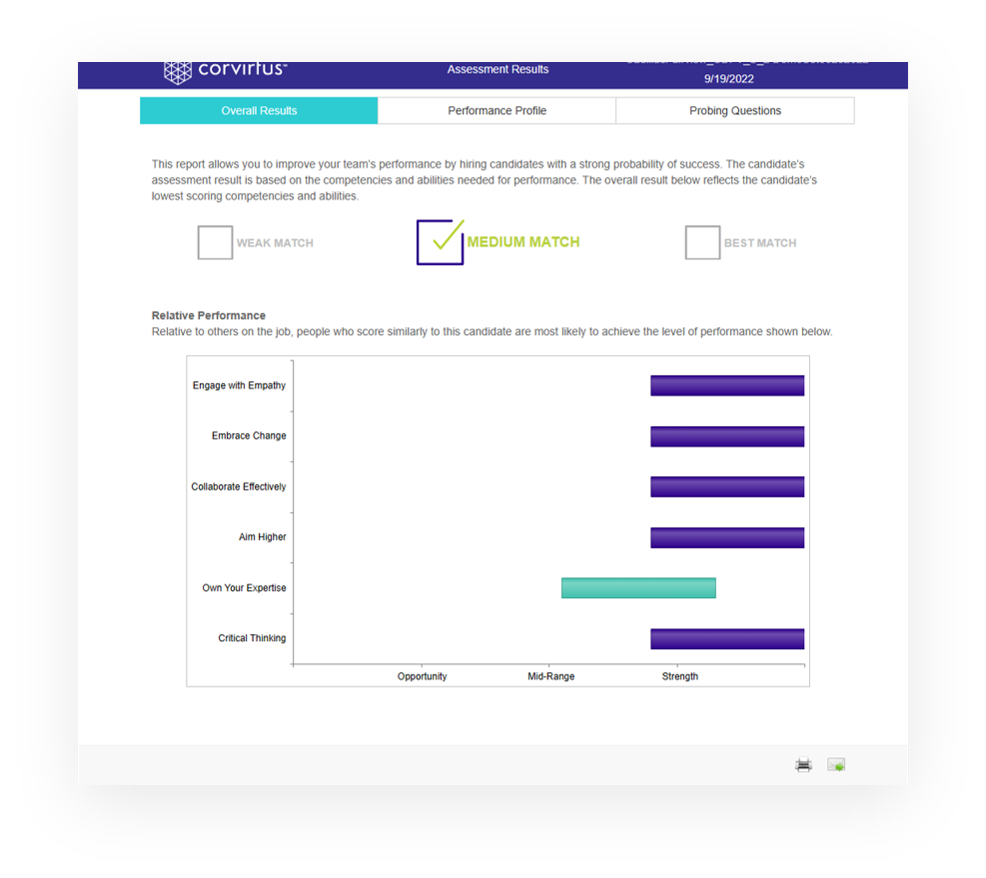
Corvirtus hiring assessments are designed to provide clear, actionable insights that enhance the hiring process. These assessments offer a quick overview of candidates’ strengths and areas for improvement, classified into three easy to understand primary recommendations.
By linking assessment results to key job behaviors and outcomes, hiring managers can make more informed decisions. Additionally, the assessments include probing questions tailored to specific roles and company cultures, ensuring a comprehensive evaluation. This approach not only streamlines the hiring process but also supports the long-term success and development of new hires.
Enhance the Candidate Experience with the Power of Assessment Tools
Incorporating tailored assessment tools into the hiring process significantly enhances the candidate experience by providing a fair, engaging, and comprehensive evaluation. These assessments not only measure candidates’ skills and abilities but also align with the company’s unique culture and values. This personalized approach ensures that candidates feel valued and understood, increasing the likelihood of attracting top talent who are well-suited for the organization. Additionally, tailored assessments can uncover hidden talents and provide valuable insights that support both hiring decisions and long-term employee development.
Customized Assessments. Showcase your company’s distinct operations, brand, and culture, guaranteeing a personalized and captivating candidate experience.

Tailored Assessments
Reflect your company’s unique operations, brand, and culture, ensuring a personalized and engaging candidate experience.Uncover Hidden Talents
Identify unique strengths and abilities that may not be evident from resumes or initial interviews.
Fair & Objective Evaluation
Provide a consistent and unbiased method for evaluating candidates, eliminating subjectivity and bias.
Data-Driven Insights
Use assessment results to inform hiring decisions, improving the accuracy and quality of hires.Eight Excuses Why You Are Not Using Hiring Assessments
Eight Excuses - Part 1
- It’s an Unneeded Expense
- My Company Is Too Small
- Candidates Can Fake Their Responses
- We Open Ourselves to Legal Risk
Eight Excuses - Part 2
- It Doesn’t Work
- It Takes Too Much Time
- I Am a Better Judge than an Assessment
- I Need to Hire for Experience and Skills, Not Personality
Selecting hiring assessments for customer-facing roles involves understanding job requirements, aligning assessments with company culture, ensuring reliability and validity, and planning for a positive candidate experience. It includes promoting diversity, implementing and monitoring the assessments, continuously improving the process, and using assessments to identify and develop future leaders.
- Determine Technical Job Requirements: Understand the specific knowledge, skills, abilities, and other characteristics (KSAOs) necessary for success.
- Assess Your Culture: Ensure the assessments align with your company’s vision, values, and customer experience goals.
- Determine What to Assess: Identify which qualities are essential on day one and which can be developed over time.
- Evaluate Assessment Reliability and Validity: Choose assessments that consistently and accurately measure job performance predictors.
This guide to selecting assessments provides the next six detailed steps for choosing and applying hiring assessments to improve hiring precision and foster long-term success for employees in customer-facing positions.
New Manager Retention: Stop, Collaborate, and Listen
Objective Evaluation
Hiring assessments provide a consistent and unbiased method for evaluating candidates, reducing reliance on subjective judgments.Predictive Validity
Hiring assessments are designed to predict job performance and fit, ensuring that candidates possess the necessary skills and traits for success.Enhanced Decision-Making
By offering data-driven insights, hiring assessments help hiring managers make more informed and accurate hiring decisions.Corvirtus case studies highlight the successful implementation of their talent management solutions across various industries. These studies showcase how Corvirtus has helped organizations build and strengthen company culture, improve employee retention, and enhance leadership development. For example, in the healthcare sector, Corvirtus tackled retention and engagement issues through stay and exit research. In the restaurant industry, they increased the talent pool and improved hiring for fit, performance, and longevity. Each case study demonstrates the tangible benefits of using Corvirtus’ assessments and tools to drive organizational success and employee satisfaction.
Takeaways
Corvirtus realistic job previews (RJPs) provide candidates with essential information early in the hiring process, equipping them to thoughtfully evaluate the opportunity and supporting both candidate preparedness and sound hiring decisions; by integrating Corvirtus RJPs, organizations benefit from higher retention and more engaged employees, as authentic expectations are set and fulfilled from the outset.
Conclusion
Realistic job previews help companies attract and retain the right talent by giving candidates a transparent view of the role and organizational culture before hiring decisions are made. By providing clear and relevant information about job expectations, challenges, and rewards, RJPs enable candidates to assess their fit for the position and company values. This informed approach ensures that new hires are well-prepared and aligned with the culture, resulting in a smoother hiring process, improved candidate experience, and increased employee engagement and retention.