
Drive Employee Engagement
Surveys and strategies for retaining and engaging your workforce
Start a Conversation
Boost loyalty and engagement with evidence-based strategies
Elevate employee loyalty and commitment through our evidence-based engagement solutions. Reducing turnover starts with earning trust and knowing the thoughts, intentions, and challenges of your employees.
Corvirtus empowers you and your employees by acknowledging their needs and fostering their growth. Tailored solutions build action plans for growth and development. Strengthen engagement in ways that further strengthen your mission and key results.
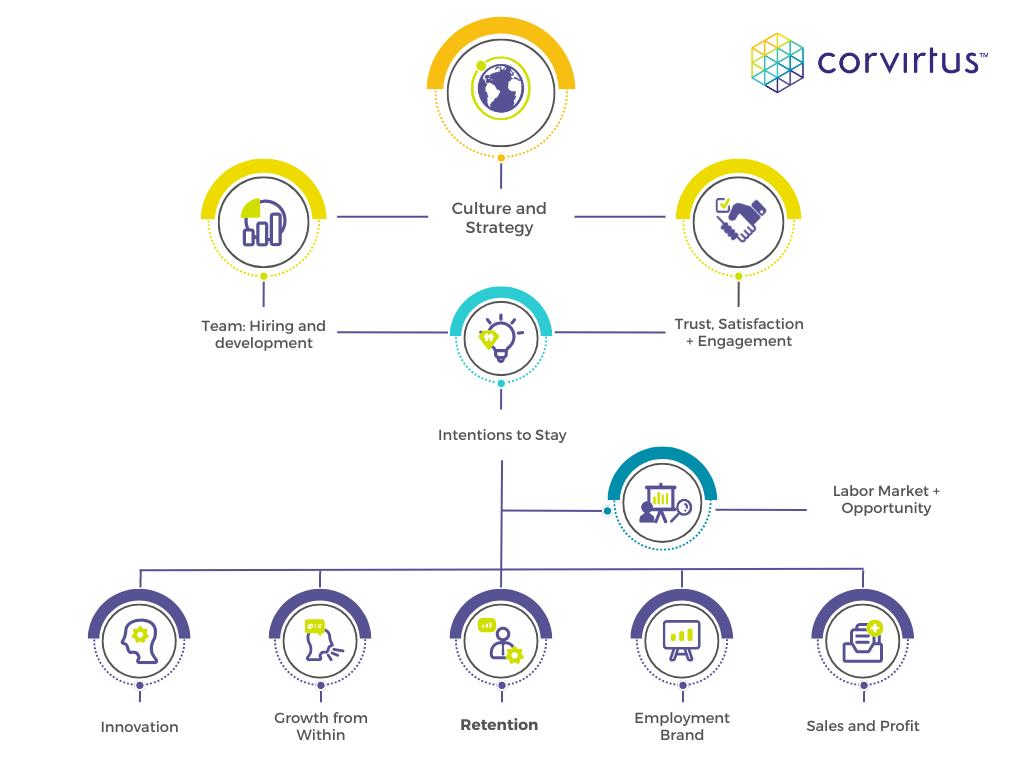
Our recipe for employee retention
Effective employee retention hinges on aligning culture with the vision for staff experience. Engagement surveys identify success drivers, isolate areas for improvement, and target barriers to success.
Understand Your Workforce
Discover the factors affecting employee retention and turnover. We'll guide you in implementing targeted strategies to effectively engage and listen to your workforce.
Measure What Matters
Monitor the drivers of engagement and turnover by letting us take care of all the logistics of feedback gathering and analysis.
Act on Insights
Equip leaders with realistic action plans building trust, retention, and performance. Ongoing partnership around employee feedback, stay-and-exit interviews, and performance analytics drive continuous improvement.
Engage & retain employees
Maximize survey insights to enhance employee engagement, earn customer loyalty, and diminish turnover.
Core and Enhanced Surveys assess engagement predictors and employee experience, including what drives intentions to stay.
Pulse Surveys offer periodic team feedback and monitor progress.
Custom Surveys reflect your culture and answer your most important questions.
Corporate-field Surveys build unity and alignment across field and corporate teams, earning trust and improving communication and results. expectations, close performance gaps, and provide action items for improving.
How much is turnover costing your organization? Access our calculator.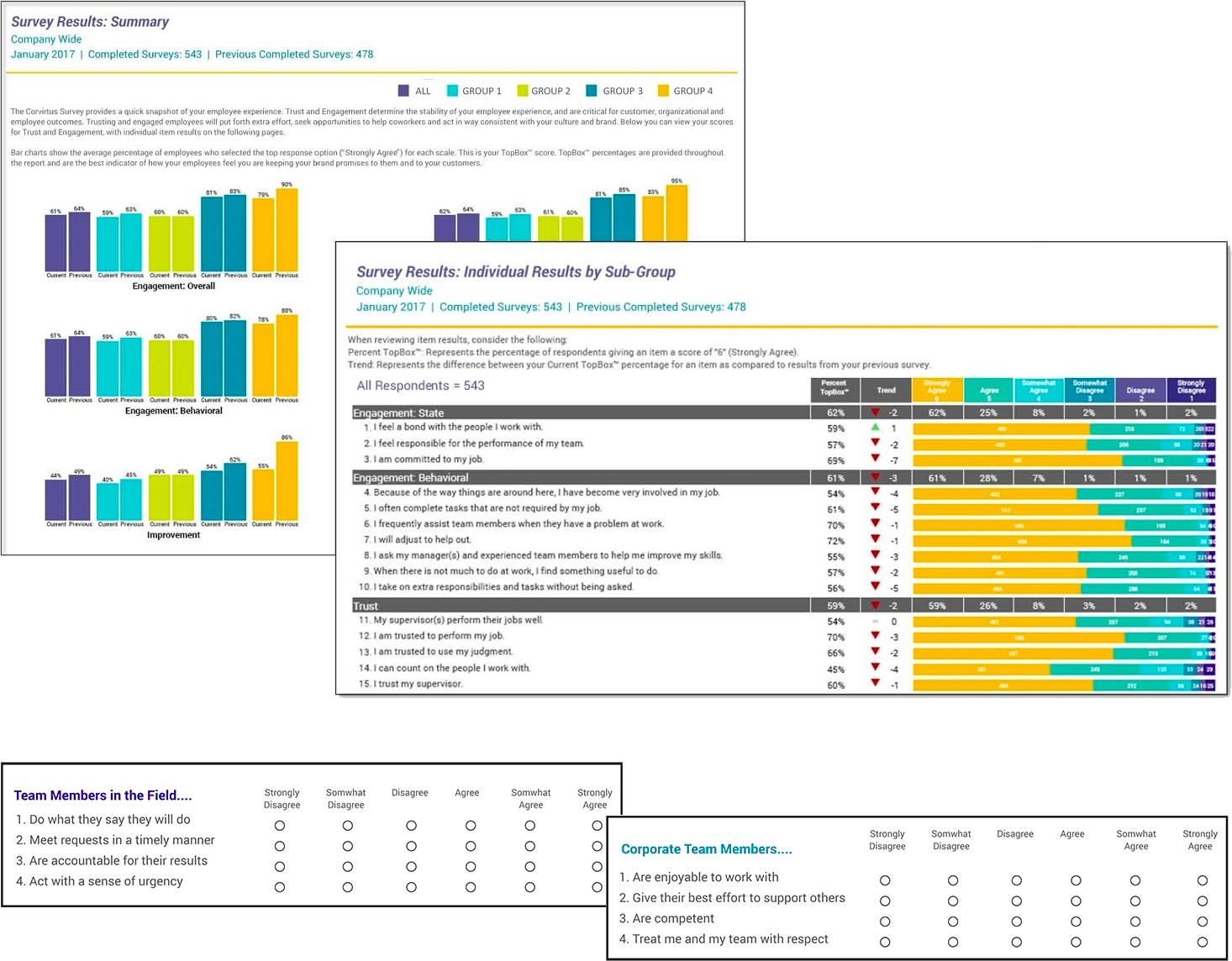
Frequently Asked Questions: Employee Retention + Surveys FAQ
1. What is the true cost of employee turnover in my organization, and how do I calculate it?
The cost goes far beyond recruiting fees. For a $45,000 employee, total replacement cost is $37,478.94–that’s 83% of their annual salary. This includes vacancy costs of $8,289 (lost productivity while others cover the role), separation and hiring costs of $2,104 (exit interviews, screening, interviews), training costs of $6,883 (manager onboarding time), and productivity loss of $20,202 (ramp-up to full effectiveness).
Here’s the bigger picture: at a 10% profit margin, you need $374,790 in additional revenue to offset losing one $45,000 employee. Multiply that by your turnover rate to see your true annual cost. Organizations using data-driven retention strategies and surveys achieve 58% decreases in turnover. You can download the turnover calculator to calculate your organization’s specific costs.
2. What types of surveys should we use and when should we deploy each one?
Different surveys serve different purposes in your listening strategy. Core and Enhanced Engagement Surveys establish baseline understanding of what drives retention and identify systemic issues across your organization. Pulse Surveys provide periodic check-ins for real-time data rather than waiting a full year between insights. Stay Interviews are proactive conversations with talent you want to keep–think of them as preventive maintenance that addresses issues before they become resignations. Exit Interviews provide forensic learning to identify patterns and prevent future departures. 360-Degree Feedback strengthens leadership self-awareness, which research shows is a key predictor of leadership success, and creates foundation for targeted coaching programs. Custom Surveys address specific challenges like change management or well-being initiatives unique to your organization.
The most effective approach combines these into a listening strategy that matches your organization’s rhythm and priorities.
3. What do we do with survey results once we have them–how do we turn data into action?
Survey data becomes valuable when it informs specific actions. Many organizations face analysis paralysis–having data but struggling to prioritize where to focus resources. Start with the leadership foundation, because research shows employee experience quality never exceeds leadership quality. Deploy 360-degree feedback and Leadership Coaching first–improvements cascade to team experience.
Fix systemic procedures next, because survey data reveals where systems contradict stated values. Address these procedural issues before expecting behavior change. Then deploy targeted development using tools like PIDR for performance conversations, Growth Map for career pathing, or CEP for identifying internal entrepreneurs. Monitor progress with pulse surveys to track whether interventions work rather than waiting another year. Critical note: data without action breeds cynicism. Even when you can’t address everything, communicate what you’re prioritizing and why. See the survey-to-action process in our case studies.
4. How do we get employees to actually participate in surveys and provide honest feedback?
Low participation signals trust issues, not apathy. When 70% don’t respond, they’re saying they don’t believe feedback matters or don’t feel safe sharing it. Connect surveys to purpose–research shows the more meaning people perceive, the more they participate. Explain how data informs specific decisions about career development or workload, not just organizational data collection.
Demonstrate past action by sharing “you said, we did” examples. Show concrete changes from previous surveys–this is the most powerful driver of future participation. Build trust through anonymity by guaranteeing it and explaining technical safeguards. For smaller teams where anonymity is difficult, consider stay interviews instead. Create urgency with limited-time windows that signal importance, and use public recognition of participation rates (not individual responses) to build momentum. Be transparent when you can’t act on everything–employees appreciate honesty over silence. Learn more about participation strategies in our case studies.
5. How does organizational culture actually impact employee retention, and can surveys measure it?
Former Merck CEO Richard Clark said it best: “Culture eats strategy for lunch.” No matter how well-designed your retention strategy, culture can defeat it. Culture operates through five measurable layers: core beliefs and values (what leadership truly believes about success), vision and goals (the imagined future like “remarkable place to work”), policies and strategies (talent management systems supporting that vision), procedures and behaviors (daily actions creating actual employee experience), and symbols and outcomes (turnover rates, engagement scores, employer brand).
A strong culture exists when all layers align. A healthy culture exists when those aligned layers also connect to enterprise success. Surveys measure gaps between these layers–they reveal whether stated values match lived experience, where procedures undermine goals, and which cultural elements predict retention versus turnover. Understanding your actual culture (not your stated culture) enables better hiring for genuine fit and more effective development programs. Read more about organizational culture and the five-layer model.
6. What ROI can I expect from investing in employee engagement surveys and retention programs?
Organizations implementing comprehensive survey and retention programs achieve 58% decreases in turnover, 50% decreases in time-to-hire, and 33% decreases in training time. Research also shows that positive collaboration links to 2.3 times greater retention of frontline staff.
Here’s how to calculate your ROI: For 100 employees at $45K average salary with 30% turnover, your current annual cost is 30 departures times $37,479, which equals $1,124,370. After a 58% reduction, you’d retain 17 employees who would have left, creating a first-year benefit of $637,143 in avoided costs. At a 10% profit margin, that’s equivalent to $6.37 million in revenue you don’t need to generate.
Beyond cost avoidance, engaged employees contribute more discretionary effort, customer experience improves (research shows it cannot be built on mediocre employee experience), and employer brand strengthens. These results come from integrated approaches–combining surveys with hiring assessments and development programs. Calculate your specific savings or review documented results in our case studies.
7. How do we prioritize which issues to address first when survey results reveal multiple problems?
When surveys identify twelve issues but budget allows addressing three, sequence matters. Start with leadership foundation because employee experience quality never exceeds leadership quality. Self-awareness is among the greatest predictors of leadership success, so deploy 360-degree feedback and Leadership Coaching first–one strong leader transforms the experience of 10–20 employees.
Next, fix systemic procedures that cause daily friction before expecting behavior change. Survey data reveals where systems contradict stated values–address these structural issues second. Once leadership is solid and systems support your goals, deploy targeted development using PIDR for performance conversations, Growth Map for career pathways, or CEP for identifying entrepreneurs. Finally, address specific programs for collaboration (which research links to 2.3 times greater retention), well-being, and recognition systems. Look for quick wins that build credibility while working on structural changes. See prioritization approaches in action or learn how hiring assessments can prevent issues from entering your organization.
8. Our leadership team doesn’t believe in “soft” metrics like engagement–how do I prove surveys drive business results?
Translate engagement metrics to financial language. Employee engagement means discretionary effort and retention rates. Culture initiatives are turnover cost reduction strategies. Surveys serve as early warning systems for financial leakage. Well-being programs manage productivity and absenteeism.
Build your case with these proof points: Each $45K employee departure costs $37,479, so multiply that by your turnover rate to show current capital leaked. Organizations achieve 58% turnover reductions, 50% faster hiring, and 33% faster training using survey-driven retention strategies. Research shows positive collaboration creates 2.3 times greater retention. At 10% profit margins, each prevented departure equals roughly $375,000 in revenue you don’t need to generate.
The causal chain is clear: employee experience drives customer experience, which drives business results. Research confirms you cannot build sustainable customer experience on mediocre employee experience. Present your case as capital preservation and reallocation, not expense. Calculate your business case using your actual numbers.
9. How long does it take to see measurable improvements in retention after implementing survey-driven changes?
Different metrics move at different speeds. In the first few months, you’ll see early signals like survey participation rates showing growing trust, stay interview feedback revealing sentiment shifts, and managers noticing increased engagement. Over the next several months, engagement scores trend upward, internal referral rates increase, and intent-to-stay responses shift positively–these precede actual retention changes.
Actual turnover rate reductions, training time decreases, and time-to-hire improvements require a full annual cycle to measure with statistical significance. Organizations achieving 58% turnover reductions sustained commitment through full implementation rather than expecting quick fixes. Rather than promising specific timeframes, communicate the progression: you’ll track participation and engagement monthly or quarterly, while retention impact requires a full year for statistical validity because you need to see patterns across multiple quarters and hiring cycles. Review improvement trajectories in our case studies to see how this progression unfolds.
10. How do employee surveys connect to our hiring assessments and development programs?
Integration creates a system where each component improves the others. Surveys inform hiring by revealing which traits predict staying–if collaborative employees show 2.3 times greater retention, you can refine hiring assessments to identify collaboration. Exit interviews reveal culture fit gaps to screen for during hiring.
Hiring informs development because pre-employment assessments establish each person’s capability baseline, enabling seamless transition to tools like PIDR for ongoing development. CEP can identify entrepreneurs during hiring for immediate development planning. Development addresses survey insights directly–stay interviews reveal growth gaps that Growth Map addresses, 360-degree feedback identifies leadership blind spots that Leadership Coaching resolves, and survey data targets development resources where they matter most for retention.
Surveys close the loop by measuring whether interventions work through pulse surveys and validating whether development programs address concerns raised in stay interviews. The documented results–58% turnover reduction, 50% faster hiring, 33% faster training–come from this integrated system working together. See integrated approaches in our case studies.