
The Multi-Site Hiring Problem No One Talks About Enough
You're managing talent acquisition across 12 locations. Each site manager has their own gut-feel criteria. Turnover at Location 7 is running at 60% annually. Location 3 can't figure out why their hires don't last past 90 days. And corporate is asking you to cut time-to-hire while also improving quality.
Sound familiar?
Mid-market, multi-location employers sit in one of the trickiest spots in talent acquisition. You're too large to run informal, judgment-based hiring at scale — but you may not have the enterprise budget or dedicated HR teams and I-O psychologists that Fortune 500 companies rely on. The good news: validated pre-employment assessments are no longer just an enterprise tool. Nor do you have to be a large enterprise to build and use hiring assessments tailored to your culture and job expectations. And when implemented correctly across locations, they solve the exact problems that plague multi-site hiring operations.
This guide walks you through every step — from choosing the right science-based hiring assessment tools to integrating with your ATS, meeting EEOC compliance requirements, and proving ROI to stakeholders who want to see numbers.
What Makes a Pre-Employment Assessment "Validated"?
Before we get to implementation, it's worth being precise about what "validated" actually means — because not all assessment vendors use the term correctly. And we heard wisdom begins with the definition of terms.
A validated pre-employment assessment is one that has been demonstrated to predict job performance through accepted scientific methods. The U.S. Equal Employment Opportunity Commission (EEOC) and its Uniform Guidelines on Employee Selection Procedures (UGESP) recognize three validity strategies:
-
Criterion-related validity establishes a statistical relationship between scores on an assessment and actual measures of job performance. This is the gold standard for high-volume hiring roles — you need a sufficient sample size, but when done rigorously, it gives you the strongest evidence that scores predict who will succeed.
-
Content validity demonstrates that the content of the assessment is representative of the important work behaviors required on the job. This approach is particularly appropriate for skills-based tests and work samples where the assessment closely mirrors actual job tasks.
-
Construct validity shows that the assessment measures a meaningful psychological construct — traits like conscientiousness or cognitive ability — and that the construct is genuinely relevant to job performance in the role.
Why does this matter for multi-site employers specifically? Because the EEOC's adverse impact provisions apply to every location and every selection procedure. A "personality quiz" your regional manager found online (or started using 20 years ago that was given to them by their manager) isn't a validated assessment. If it has disparate impact on a protected class and you can't demonstrate validity, you have legal exposure — multiplied across every location using it.
Simple 7-Step Assessment Implementation Framework
Step 1: Define What "Quality Hire" Means for Your Business - for all locations
This is the step most organizations skip, and it's why their assessment programs underperform.
A validated assessment is only as good as what it's predicting. Before selecting any pre-employment assessment platform, you need a clear, operationally defined picture of what success looks like in the roles you're hiring for. This means going beyond "culture fit" as a gut-feeling and identifying specific, observable behaviors and outcomes.
Start by asking:
- What do your top performers do differently in the first 90 days?
- What behavioral patterns show up consistently in your lowest-retention hires?
- Do success factors differ by location, or are they consistent across locations?
- What do site managers mean when they say a hire "just didn't work out"?
For multi-location companies, this step should involve structured conversations with site managers across at least three to five locations (or 30 percent of your locations) before any assessment selection begins. The goal is to identify both the shared criteria that should be consistent company-wide and the location-specific variables that may require flexibility.
We talk about this as building a "vision of success" — the documented, role-specific profile of what you're actually trying to predict. You're documenting what makes team members successful and what derails them. Often our strengths can become potential pitfalls and you may find this in your conversations, especially if you're exploring managerial performance, where what once supported success is often no longer important. Assessments built against this profile are far more likely to deliver measurable quality-of-hire improvements than off-the-shelf tools applied generically.
 Photo by Marco Chilese on Unsplash
Step 2: Choose the Right Assessment Type for Each Role
Not every role needs the same assessment approach. Using the wrong assessment type for a given role wastes candidate time, creates drop-off, and produces noisy data. Here's how to match assessment type to hiring context for common mid-market roles:
Cognitive aptitude assessments measure a candidate's capacity to learn, process information, and solve new problems. Meta-analyses published in peer-reviewed journals consistently show cognitive ability as among the strongest predictors of job performance across role types. These are particularly valuable when you're hiring for roles where on-the-job learning is significant — where how fast someone ramps matters as much as what they already know.
Personality and behavioral assessments measure stable work-relevant traits such as conscientiousness, adaptability, interpersonal orientation, and how someone approaches challenges and decision-making. For multi-location employers, behavioral assessments are especially useful because they capture the potential to live and strengthen your culture before the hire — reducing the "just didn't fit" turnover that's expensive and hard to explain.
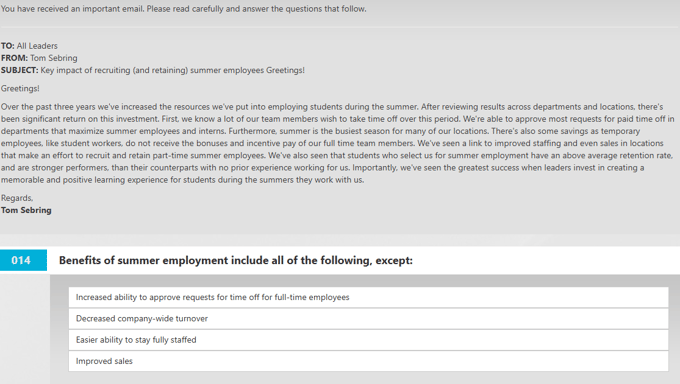
Situational judgment tests (SJTs) present candidates with realistic workplace scenarios and ask how they'd respond. SJTs are highly effective for customer-facing, supervisory, and management roles where judgment under ambiguity matters. They also tend to have strong candidate acceptance rates because they feel directly relevant to the job.
Job simulations and work samples have the highest predictive validity of any assessment type but take longer to complete and score. For specialized roles where specific skills are critical — a culinary position, a technically complex operations role, a patient-facing healthcare position — they're worth the investment.
The final assessment will connect cognitive, personality, and situational elements into a single candidate experience are the current best practice for your business. The goal is a complete picture of the candidate without requiring less time phone screening, interviewing, or squinting at job applications trying to decipher potential. Our approach is to combine multiple assessment dimensions into a single streamlined experience that measures only what's predictive of success in your specific roles.
Concerned about assessment length? Or an assessment being a barrier to staying fully staffed? That's a valid concern. Corvirtus usually delivers assessments shorter than 30 minutes for managerial and professional roles and 15 minutes for frontline and hourly roles. But assessments are tailored to meet your vision for the candidate experience. We know do not meaningfully increase when we stay within these thresholds — a real concern when you're managing candidate flow across dozens of locations simultaneously.
Step 3: Establish Your Compliance and Legal Framework
This step is non-negotiable for any multi-site employer, and it should happen before you deploy any assessment program — not after an EEOC charge.
Understand adverse impact requirements. Under the Uniform Guidelines for Selection Procedures, if a selection rate for any race, sex, or ethnic group that is less than four-fifths (80%) of the selection rate for the highest-selecting group, adverse impact is indicated. This applies to every component of your selection process — including assessments — and to every location.
For multi-site employers, this means adverse impact monitoring needs to happen at the enterprise level and ideally at the location level for high-volume sites. You cannot simply assume that because your aggregate numbers look clean, every location is in compliance.
Key compliance requirements for multi-site assessment programs:
-
Your assessment vendor should be able to provide documented validity evidence specific to the roles and industries you're hiring for. Generic test manuals citing validity studies from unrelated industries are not sufficient. Ask vendors specifically for criterion-related validity studies conducted on populations similar to your applicant pool.
-
Your vendor should also provide adverse impact reporting. This means the platform surfaces differential selection rates by protected class so your team can monitor for disparate impact in real time — not during an audit.
-
Assessment content must be demonstrably job-related. This is why the "vision of success" work in Step 1 is so foundational. If you can't connect each assessment dimension to observable job requirements, you're taking on unnecessary legal risk.
-
Maintain records. The Uniform Guidelines on Employee Selection Procedures requires users to maintain data on applicant flow, selection rates, and adverse impact by race, sex, and ethnic group. For multi-site employers, this means your assessment platform needs to generate the documentation you'd need to demonstrate compliance. Build this into your vendor evaluation criteria from day one.
A note on cultural fit assessments and bias. Culture-focused hiring assessments are valuable, but they carry the highest risk of perpetuating homogeneity if not carefully designed and validated. Look for vendors who build cultural assessments against defined, measurable values — not vague "fit" intuitions — and who include adverse impact auditing in their standard reporting.
Step 4: Evaluate and Select Your Pre-Employment Assessment Platform
With your role requirements defined, assessment types mapped, and compliance requirements understood, you're ready to evaluate vendors. Here are the criteria that matter most for multi-location mid-market employers:
-
Scientific validity documentation. Ask each vendor for their technical manual and validation studies. Look for criterion-related validity evidence, preferably from industries and role types similar to yours. Corvirtus's assessments, for example, are scientifically validated and customized to client-specific visions of success — not applied generically from an off-the-shelf library.
-
Customization depth. One-size-fits-all assessments are a red flag for multi-site employers. You need a platform that can accommodate role-level customization while maintaining enterprise-level consistency. The ability to set location-specific or role-specific benchmarks — without rebuilding the entire program — is a significant operational advantage.
-
ATS and HRIS integration capability. Assessed in detail in the next step, but evaluate this at the selection stage. Ask for a specific list of ATS integrations (ours is here), and verify that integration is native (not just a Zapier workaround) before signing a contract.
-
Adverse impact reporting. Does the platform automatically generate adverse impact analyses by protected class? Can you run these reports at the enterprise level and the location level? Is this a standard feature or an add-on?
-
Candidate experience quality. For multi-location hiring, the candidate experience is a competitive differentiator. Look for mobile-optimized delivery, clear and engaging assessment interfaces, and appropriate assessment length for your target candidate populations. Research consistently shows that poorly designed candidate experiences reduce completion rates and damage employer brand — problems that compound across dozens of locations.
-
Implementation support. Look for vendors who provide genuine implementation support — not just a help center link — including assistance with job analysis, benchmark setting, and initial reporting configuration.
-
Scalable pricing. Per-assessment pricing models can become very expensive very fast for high-volume multi-site hiring. Understand total cost of ownership at your projected hiring volume before committing.
Step 5: Integrate Assessments Into Your ATS Workflow
The biggest threat to an assessment program isn’t the assessment itself—it’s friction. Any process that feels manual, optional, or disconnected from how hiring actually happens is more likely to be skipped by managers and abandoned by candidates.
Seamless workflows matter. In some environments, that means direct ATS integration. In others, it means a clearly defined, well-supported process that works with existing systems. The goal is the same either way: make the assessment a natural, unavoidable part of hiring—not an extra step people work around.
Standard integration architecture for multi-site assessment programs:
The most effective setup triggers assessment delivery automatically when a candidate reaches a defined stage in your ATS (typically after an initial application screen or phone screen). The candidate receives an assessment link via email or SMS without any manual action from a recruiter or site manager. Results are returned directly to the candidate's profile in the ATS within the platform's scoring timeframe.
Workflow design considerations for multi-location hiring:
-
Placement in the funnel matters. Assessments placed too early (immediately after application) create friction for passive candidates and can reduce top-of-funnel volume. Assessments placed too late (after multiple interview rounds) waste recruiter time on candidates who would have screened out earlier. For most mid-market roles, placement after an initial application screen but before the first site manager interview is the sweet spot.
-
Standardize across locations. One of the core advantages of a validated assessment program is that it creates a consistent standard across every location — not just the ones where site managers happen to be rigorous interviewers. Document the assessment stage as a required step in your hiring workflow and communicate it consistently to all location managers during rollout.
-
Configure threshold alerts thoughtfully. Most platforms allow you to set score thresholds that flag candidates as strong matches, potential matches, or outside criteria. For multi-site programs, build in a review process before any threshold becomes an automatic pass/fail gate. Assessment scores should inform decisions — they should not replace manager judgment entirely, especially early in program implementation.

Step 6: Train Site Managers and Hiring Teams
Assessment data is only useful if the people making hiring decisions know how to use it. For multi-location employers, this is frequently where implementation breaks down — the corporate HR team understands the program, but site managers don't know what the scores mean or how to weigh them.
Core training content for site managers:
Explain what the assessment measures and why those dimensions are predictive of success in the role. Managers are more likely to use assessment data when they understand the logic behind it — not just the score.
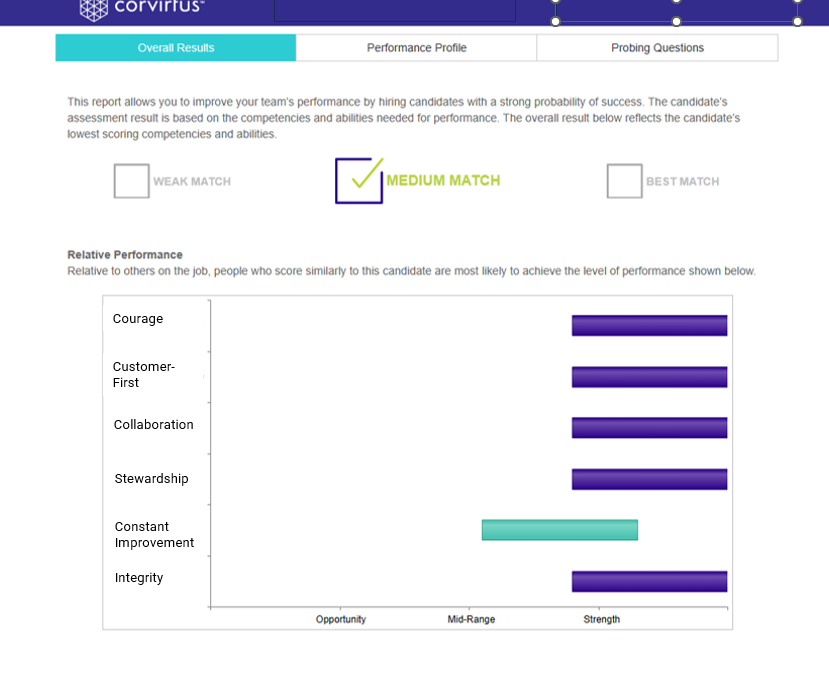
Teach them to use the full report, not just the overall result. Most validated assessment platforms generate profile reports that highlight specific strengths and areas of opportunity for each candidate. These reports are also frequently the source of targeted interview questions — a feature that directly reduces the preparation time required from site managers and improves the quality of behavioral interviews.
Address the "I just know a good hire when I see them" dynamic directly.
Research consistently shows that unstructured interviewer judgment is one of the weakest predictors of job performance. Validated assessments outperform gut instinct in controlled studies. Help managers understand this not as a critique of their judgment but as a tool that makes their judgment more reliable.
Clarify what assessments can and cannot tell you. Validated pre-employment assessments are strong predictors of performance patterns and cultural alignment — they are not infallible predictors of every individual outcome. Managers should use assessment data as one important input among several, not as the sole basis for hiring decisions.
Rollout sequencing for multi-site programs:
For large multi-location employers, a phased rollout — starting with two or three pilot locations before scaling company-wide — is typically more effective than a simultaneous launch. Pilot locations allow you to identify integration issues, gather early data on completion rates and adverse impact, and build internal case studies that help drive adoption at remaining locations.
Step 7: Measure Quality-of-Hire ROI and Optimize Continuously
This is the step that transforms a hiring assessment program from a cost center into a business asset — and it's where most mid-market companies stop too early.
The core quality-of-hire measurement framework:
Track assessment score distributions by location and role from day one. You need baseline data before you can measure improvement.
Connect assessment data to post-hire outcomes at 30, 60, and 90 days. The metrics that matter most vary by role but typically include:
-
Early retention rate (still employed at 90 days)
-
Manager-rated performance at 60 days
-
Time-to-productivity (how quickly new hires reach independent performance
-
Early departure rate (voluntary and involuntary separations in the first six months)
Run analyses comparing assessment results to performance.
Do candidates who scored in the top tier on the assessment perform better at 90 days than those who scored in the bottom tier? Does a higher assessment score correlate with lower 90-day turnover? If yes — you've built an internal validity case that's more compelling than any vendor case study. If the correlation is weak, that's a signal to revisit Step 1 and sharpen your vision of success criteria.
Track adverse impact quarterly. Build this into your standard HR reporting cadence, not as a one-time audit. For multi-site employers, generate the report at both the enterprise level and for your highest-volume locations.
Key metrics to include in stakeholder reporting:
- Turnover rate (before and after assessment implementation, by location)
- Time-to-hire (total days from requisition open to offer accepted)
- Time-to-productivity (defined per role)
- 90-day retention rate
- Cost-per-hire (including cost of turnover avoided)
- Assessment completion rate (signals candidate experience quality)
- Adverse impact ratios by protected class
- Other key performance indicators core to your vision of success (where we started in step one)
Corvirtus clients using validated hiring assessments have reported outcomes including a 58% decrease in turnover, 50% decrease in time-to-hire, and 33% decrease in training time within a single year. These are not typical outcomes in year one without the full implementation framework — but they are achievable when assessment design, manager training, and outcome measurement are all in place.
Common Implementation Mistakes to Avoid
-
Selecting a vendor before defining success criteria. The assessment should be built around what you've defined as a quality hire — not the other way around.
-
Treating validation as the vendor's problem. You bear legal responsibility for demonstrating job-relatedness and adverse impact compliance, regardless of what your vendor claims. Request documentation and understand it.
-
Deploying without ATS integration or carefully crafting a seamless workflow. Manual assessment administration creates friction and can cause inconsistent candidate experiences. If the integration isn't possible, seek to make the process as simple as possible.
-
Setting hard cut-off scores too early. In the first months of implementation, use assessments to inform decisions rather than automate them. Let the data accumulate before hard gates are appropriate.
-
Skipping manager training. Adoption is a people problem as much as a technology problem. Site managers who don't understand or trust the assessment will find ways around it.
-
Measuring only activity, not outcomes. Completion rates and time-to-hire are useful operational metrics, but they don't prove the program is working. Connect assessment data to post-hire performance data to build the ROI case.
Choosing the Right Partner for Multi-Site Assessment Implementation
Mid-market companies managing multi-location hiring need more than a software platform — they need a partner that understands the operational complexity of their environment and can provide both scientific rigor and practical implementation support.
The most important questions to ask any pre-employment assessment platform vendor:
-
What validity evidence do you have for my specific roles and industries? Generic manuals aren't sufficient — you want studies conducted on populations similar to your applicant pool.
-
How do you handle adverse impact monitoring across multiple locations? Ask to see the actual reporting interface, not just a feature list.
-
What does your implementation process look like for a company with our hiring volume and location footprint? Get a specific timeline and support model, not a generic onboarding promise.
Can you show me examples of quality-of-hire outcomes at companies similar to ours? Request references from clients with comparable role types, company size, and location complexity.
The Bottom Line
Multi-site, mid-market talent acquisition is one of the most execution-intensive challenges in HR. Validated pre-employment assessments, implemented correctly, address the core problem: inconsistent hiring standards across locations that produce inconsistent quality outcomes.
The seven-step framework above — defining success criteria, selecting the right assessment types, building the compliance foundation, evaluating platforms, integrating with your ATS, training your managers, and measuring outcomes — is the full implementation picture. Each step builds on the one before it. Organizations that invest in the full framework see material improvements in retention, time-to-hire, and quality of hire. Those that skip steps — particularly validation evidence, adverse impact monitoring, and post-hire outcome measurement — get neither the business results nor the legal protection they're looking for.
Our team at Corvirtus helps mid-market companies build science-based hiring assessment programs customized to their specific roles, cultures, and visions of success — with the implementation support to make assessment programs work across every location, not just at headquarters.
Frequently Asked Questions
What is a validated pre-employment assessment? A validated pre-employment assessment is a hiring tool that has been scientifically demonstrated to predict job performance through criterion-related, content, or construct validity studies conducted in accordance with professional psychological standards and EEOC guidelines. Validation means the assessment measures something real and job-relevant — not just that it produces scores.
How do validated assessments help with multi-location hiring consistency? Validated pre-employment assessments create a standardized, objective hiring criterion that applies equally across every location. Rather than relying on each site manager's individual judgment, every candidate is evaluated against the same science-backed profile of what predicts success in the role — reducing the location-to-location variability in hiring quality that drives inconsistent turnover and performance outcomes.
What EEOC requirements apply to pre-employment assessments? Under the Uniform Guidelines on Employee Selection Procedures (UGESP), any selection procedure with adverse impact on a protected class must be demonstrated to be job-related and valid. The 4/5ths (80%) rule is the standard threshold for identifying adverse impact. Multi-site employers must monitor adverse impact for each location and maintain records of applicant flow and selection rates by race, sex, and ethnic group.
How long does it take to implement a validated assessment program across multiple locations? A full implementation — including job analysis, assessment customization, ATS integration, and manager training — typically takes six to twelve weeks for a mid-market company. Phased rollouts starting with two to three pilot locations before scaling company-wide are generally recommended for employers with ten or more locations.
What's the difference between science-based hiring assessment tools and standard personality tests? Science-based hiring assessment tools are built on peer-reviewed research, validated against actual job performance data, and designed to comply with EEOC legal requirements. Standard personality tests — including many popular consumer-facing tools — may produce interesting results but lack the job-specific validity evidence and adverse impact controls required for legal, defensible hiring decisions.
How do I measure ROI on a pre-employment assessment program? Connect assessment score data to post-hire outcomes: 90-day retention rate, manager-rated performance at 60 days, time-to-productivity, and early departure rate. Track these metrics by location and compare cohorts hired before and after assessment implementation. The strongest ROI case comes from demonstrating that candidates in the top assessment score tier have measurably better 90-day outcomes than those in the bottom tier.
Build Hiring Assessments That Actually Work
Corvirtus provides scientifically validated hiring assessments customized to your vision of success — built for mid-market companies managing multi-location talent acquisition. Access our hiring assessments eBook to learn more about the specific what, when, and why of assessments.